
GTW 10: mode, capacity, cleanup
Three schematic panels show separate dry and wet filter modes, total versus usable liquid volume and controlled emptying.
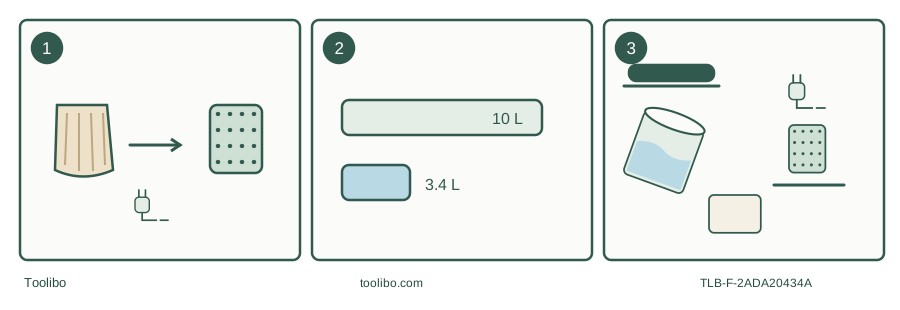
Choose the mode
Rev09: cloth for dry debris; foam for liquid pickup, not the GTW 20 rule.
Plan the batch
10 L total container; documented usable liquid capacity is 3.4 L.
Finish dry
Unplug, remove the head, empty appropriately, rinse the foam and dry fully.
Original schematic, not OEM geometry; capacity bars are conceptual, not a water-level mark.
Identify the Brazilian 220 V version first
This guide covers WAP GTW 10, catalog code FW005706, for Brazil at 220 V. FW005705 is the separate 127 V version. A product selector showing both voltages does not make either machine dual voltage: match the actual nameplate to the supply before connecting it. The operating reference here is the Portuguese Rev09 manual, marked May 2024, not an older GTW 10 leaflet with different capacity figures.
The specification is 1400 W electrical input, a 1.5 m hose and a 2 m power cord. Electrical watts are not air watts and cannot be converted into a cleaning-speed promise. Treat the short cord as a layout constraint: choose a suitable outlet and a dry route before moving the vacuum into position, rather than pulling the machine with its cable.
Read three capacity figures, not just the name
The matched manual lists a 10 L total container, 3.4 L usable for liquids and 7 L usable for solids. The headline tank size is therefore not a promise of collecting ten litres of water in one run. Use the separate liquid figure when planning a manageable batch and an emptying point, while still responding to the machine rather than trying to fill a measured quota.
Think through the return journey as well as the collection task. A small tank containing water still needs a stable receiving container, room to remove the head and a controlled pour. If the route includes steps or a high sink, smaller batches may be more practical than filling to the documented limit. This is handling advice, not a measured endurance comparison.
Rev09 uses different filters for dry and wet work
For dry pickup, the matched GTW 10 instructions use the cloth dust filter. The foam motor-protection filter is for liquid pickup in this revision. Its optional dry-filter instructions explicitly say to remove the foam before fitting the dry filter; do not import the GTW 20 instruction to retain foam in both modes.
The listed cloth component is FW005258 and foam is FW005248. Optional accessories include disposable dust bag FW005736 and washable cloth option FW008889. Those optional dry components are not wet bags. Identify what is actually installed instead of assuming that every accessory shown in a diagram was included in the carton.
Before changing modes, switch off, unplug, open the side catches and remove the head. Empty remaining dry debris before wet use, remove dry media and install the wet foam correctly. Do not remove or defeat the float protection. Refit the head and secure the catches before connecting the hose and power.
Keep a suction stop separate from an electrical fault
The troubleshooting table identifies an activated float valve as a cause of lost suction and directs the user to check and empty the dirty-water container. Stop and disconnect power before that inspection. Do not continue running merely because the motor can still be heard, and do not bypass the float to obtain more volume.
If the container is not full, inspect the hose, nozzle and appropriate filter for obstruction with power disconnected. A clogged accessory and a water-level cutoff need different corrections. If the vacuum has overheated, allow it to cool and investigate the cause; persistent faults belong with authorized service rather than repeated restarts.
Finish the wet job before storing the machine
Remove the head, empty the container through a suitable disposal route and wipe out residue. Rinse the foam under running water and let it dry completely. The cloth filter has its own rinse-and-dry instructions. Neither filters nor compartments belong in a dishwasher or washing machine. The head is not a washable bucket: keep its electrical parts dry.
The manual permits cleaning the hose by drawing a little clean water through it only when the vacuum is already configured for liquids. This is not a reason to leave a dry bag installed. Allow the hose and filter to dry before reuse or storage so that the next dry task does not begin with damp material hidden inside.
Check the material before choosing a nozzle
The safety instructions exclude flammable liquids, hot material, very fine toner, plaster or cement dust, sharp objects and material harmful to health. A replacement filter does not automatically override those exclusions. Unknown renovation dust or contaminated water should be identified before cleanup, not after it is in the tank.
Disposal depends on what was collected, not on the fact that the machine can collect water. Do not pour unknown chemical or contaminated liquid into a convenient drain. Keep the contents controlled, select an appropriate local disposal route and store the empty, dry vacuum with its two filter configurations easy to distinguish.
Models referenced