
Same voltage, different filter routines
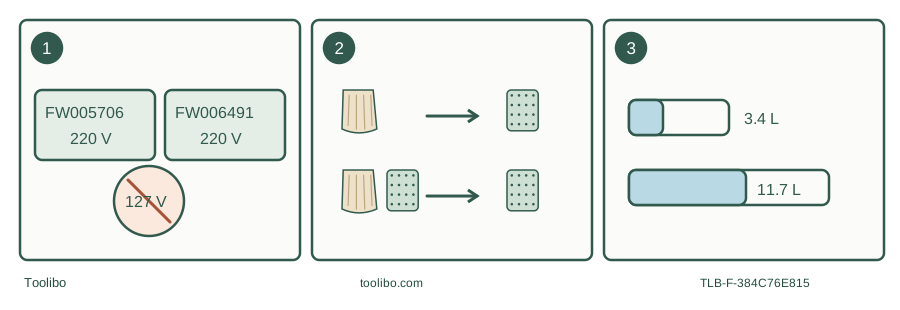
Three panels compare exact 220 V codes, dry/wet filter combinations and usable liquid volumes.
GTW 10
- 10 L total tank; manual lists 3.4 L for liquids and 7 L for solids.
- Brazil 220 V SKU FW005706; 1400 W electrical input; 1.5 m hose and 2 m cord.
GTW 20
- 20 L total tank; manual lists 11.7 L for liquids and 15.6 L for solids.
- Brazil 220 V SKU FW006491; 1600 W electrical input; 1.5 m hose and 2.5 m cord.
Match the versions
FW005706 and FW006491 are the selected Brazilian 220 V models; 127 V codes differ.
Follow each manual
GTW 10 Rev09 separates dry cloth and wet foam; GTW 20 Rev04 retains foam in both modes.
Compare usable volume
The matched liquid capacities are 3.4 L and 11.7 L, not the 10 L and 20 L tank names.
Original comparison schematic; not a manufacturer assembly diagram or measured performance chart.
Compare two Brazilian 220 V versions, not a voltage selector
This comparison covers WAP GTW 10 FW005706 and GTW 20 FW006491, both Brazilian 220 V versions. Their 127 V counterparts are FW005705 and FW006490 respectively. Neither selected machine becomes dual voltage because an online listing offers two purchase options. Confirm the exact catalog code and nameplate before comparing accessories or planning an outlet.
The operating references are GTW 10 Rev09, May 2024, and GTW 20 Rev04, September 2022. These revision boundaries matter: the documents differ in their foam-filter instructions, and older manuals have different capacity statements. This is a documentation-based comparison, not a hands-on test of suction, noise, durability or cleaning time.
The main difference is not simply ten extra litres
Swipe or scroll horizontally to see all columns.
| Documented item | GTW 10 FW005706 | GTW 20 FW006491 |
|---|---|---|
| Supply version | Brazil 220 V | Brazil 220 V |
| Electrical input | 1400 W | 1600 W |
| Total container | 10 L | 20 L |
| Usable liquid capacity | 3.4 L | 11.7 L |
| Usable solids capacity | 7 L | 15.6 L |
| Hose / power cord | 1.5 m / 2 m | 1.5 m / 2.5 m |
| Matched manual | Rev09, May 2024 | Rev04, September 2022 |
The liquid figures are more useful for planning a collection batch than the model names. A twenty-litre container is not a twenty-litre liquid allowance. Equally, a small ten-litre shell should not be treated as holding ten litres of water before emptying. Neither figure is a recommendation to carry a maximum load to an awkward sink.
The GTW 20 offers more documented usable collection volume; that can reduce the need to empty for a given suitable job, but it also allows a heavier load to accumulate. The practical question is whether you can move and empty it safely. Choose an emptying route before treating capacity as a convenience.
The same foam part has different instructions
Both manuals list foam FW005248 and cloth filter FW005258, but this does not make their operating configurations identical. GTW 10 Rev09 assigns the cloth to dry pickup and the foam to liquids; its optional dry-filter section explicitly tells the user to remove foam before installing the dry filter.
GTW 20 Rev04 requires foam during both dry and wet operation. For dry debris, the cloth filter is added at the inlet. For liquids, remove the dry cloth or bag while leaving the foam correctly fitted. A shared parts drawer therefore needs model and mode labels, not just matching part numbers.
Both list optional disposable dust bag FW005736. Optional means a package may not include it, and dry means it is not a liquid collection bag. Do not transfer a dry assembly straight into a water job because the container is called wet/dry. Switch off and unplug before opening the catches or changing filters.
Reach and electrical watts answer different questions
The two manuals specify the same 1.5 m hose length, while GTW 20 has a 2.5 m cord rather than GTW 10’s 2 m. That extra cable length is a layout fact, not proof of better cleaning. Furniture, doors and a dry, suitable socket still determine where either machine can stand without tension on the lead.
Likewise, 1400 W and 1600 W describe electrical input. They are not air watts, sustained suction at the nozzle or a direct counterpart to US peak-horsepower labels. Do not use a percentage difference in input power as a percentage improvement in pickup performance. This guide makes no such conversion.
The GTW 10 manual lists three plastic extension sections and GTW 20 lists two. Check what is supplied and how it fits before assuming that more sections provide a better working height. Their purpose is to position the nozzle without pulling the whole vacuum by the hose.
Float response and cleanup still need an operator
Both troubleshooting sections identify float-valve activation as a reason for lost suction and direct the user to check and empty the dirty-water container. Stop and unplug first. Do not defeat the float or keep running just because the motor remains audible. If the tank is not full, inspect the hose, nozzle and filters for restrictions before restarting.
After use, empty through a route suitable for the contents, clean the applicable filters and let the parts dry completely. Neither manual makes the motor head washable or permits filters in a dishwasher or washing machine. GTW 20 also explicitly excludes high-foaming cleaning liquid in its wet-use procedure.
Neither machine should be selected for flammable liquids, hot debris, very fine plaster, cement or toner, sharp objects or harmful substances. The smaller model is not the safe choice for a prohibited material, and the larger model does not create a treatment system for contaminated water. Choose between them for permitted collection volume, handling and the correct filter routine—not an assumed power ranking.
Models referenced