
Three liquid cases in the checked manual
Three schematic panels distinguish small-liquid cartridge use, larger-liquid cartridge removal and foam for debris-bearing liquid.
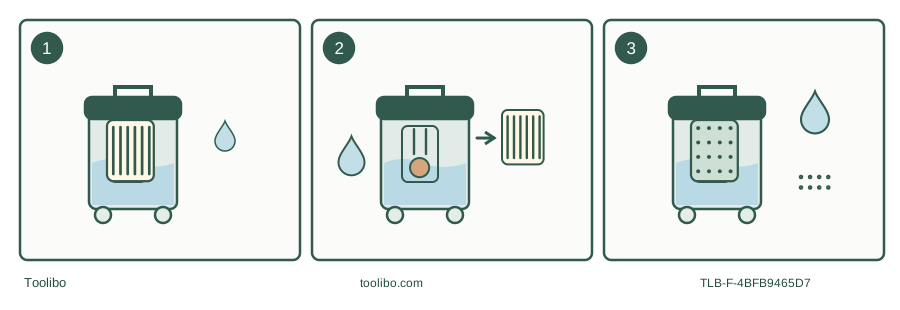
Small quantity
The checked manual permits a clean cartridge for small amounts of liquid.
Larger quantity
It recommends cartridge removal for larger amounts; keep cage and float.
Debris in liquid
It recommends a compatible foam filter over the cage for debris-bearing liquid.
Revision-specific concept, not a universal wet-vac rule; unplug before any change.
Read the suffix before the wet instructions
This guide covers the US DEWALT DXV06P, using the exact 2018 OEM instruction manual for the 120 V, 60 Hz, 8 A version. The manufacturer-branded document is available through a distributor’s document library. It is not a guide to DXV06PL, DXV06P-QT or another quiet-series version. If your supplied manual gives a different wet-filter procedure, resolve that revision difference before operating rather than combining instructions from two documents.
The documented layout is a nominal 6-gallon drum, a 1-7/8-inch by 7-foot hose and a 10-foot cord. The product listing describes a 4 peak-HP motor. Peak horsepower is not sustained operating horsepower, and nominal drum size does not establish usable liquid capacity. Use those specifications to identify the machine, not to promise a pickup rate.
Make a dry setup that you can inspect
With the vacuum off and unplugged, check the cartridge’s sealing surface and its fit over the cage. The retainer secures the cartridge; the pleated material is not a handle for forcing it into position. A clean-looking filter can still leak around a poorly seated seal. Replace torn or punctured media before use.
The disposable bag’s cardboard collar fits onto the inlet deflector, and the bag is distributed around the inside of the tank. Keep it clear of the lid joint. For ordinary dry debris, this makes removal more contained, but a bag does not grant permission to collect hazardous dust. Check the actual bag’s compatibility rather than buying one only because its advertised gallon range includes six.
Plan the nozzle route before connecting power. A hose through a partly open door needs slack and protection from pinching. Position the drum so moving the nozzle does not pull the machine into a chair leg or over its own cord. Stop and move the vacuum when the remaining reach becomes awkward.
Understand this revision’s three liquid cases
The checked manual separates liquid work more carefully than the simple phrase “wet/dry” suggests. Empty the dry contents and remove dry-use filtering such as the disposable dust bag before converting. Keep the filter cage and float installed.
For a small quantity of liquid, the manual permits a clean cartridge. For larger quantities it recommends removing the cartridge to avoid saturation and exhaust mist. For liquids containing debris, it recommends purchasing and fitting a suitable foam filter over the cage. This guide does not invent a foam-filter part number or a maximum liquid volume where the matched document does not establish one.
These instructions are tied to this DXV06P document. The DXV09P_2024 manual, for example, explicitly requires its cartridge during liquid pickup. That difference is why a remembered rule from a neighbour’s DEWALT vacuum should not determine your setup. If the installed filter or manual revision is uncertain, pause and confirm the configuration with the manufacturer.
Watch the air path, not only the water level
A float rises at its operating liquid level and closes the air path. Suction ceases and the motor sound becomes higher in pitch. Switch off, unplug and empty; do not let the motor keep running against a raised float. A six-gallon marking is not a target that must be reached before stopping.
The same conservative response applies if liquid mists from the exhaust or the machine sounds abnormal. Stop before opening the head. Inspect the filter condition, tank contents and upright position without reaching into a powered machine. Keep the motor compartment, plug and connections away from the liquid route.
End with a usable machine, not a wet storage problem
Disconnect power before removing the head or draining. Use an appropriate receiver, replace the drain cap before restarting, and reduce the load before lifting. The drain is an emptying feature, not a pump outlet for continuous operation or a permission to discharge unknown waste into a sink.
Clean the tank and attachments after wet use. Follow the manual’s cleaning method for the cartridge and allow it to dry completely before dry pickup. Its approximate drying time is not a substitute for checking actual dryness in your storage conditions. Store indoors with the cord and accessories organized.
Exclude flammable liquids and vapours, explosive dust, hot or smoking materials, and toxic substances. Ordinary liquid cleanup is the scope here, not sewage, asbestos or contaminated renovation work. Choose the disposal destination according to the contents and local requirements, and do not mix unknown collected liquids simply to make them easier to pour away.
Models referenced