
Different wet instructions, shared stop response
Exact document cards lead to different cartridge states and a shared float-stop-and-unplug response.
DXV06P
- US 120V 8A; guide scoped to exact OEM 2018 instruction manual; wet rule differs from DXV09P_2024.
- DXV06P; OEM-branded 26-page PDF on Home Depot document CDN, not an OEM-hosted URL. Cover DXV06P; printed 2 120V/60Hz/8A; 7–8 cartridge/bag/wet; 9 float; 10 cleaning; 13 copyright 2018. Later manual revisions may differ. Do not substitute DWV106 Latin America manual.
DXV09P
- US 120V 10A; DXV09P_2024 requires cartridge retained for liquid pickup; not QTA/quiet variants.
- DXV09P; 26-page 11,424,669-byte OEM PDF downloaded and extracted locally because web reader size limit exceeded. Printed 2 electrical; 8 cartridge and dry bag; 9 requires cartridge for liquids and float response; 10 requires filter for dry and wet; 11 maintenance/troubleshooting.
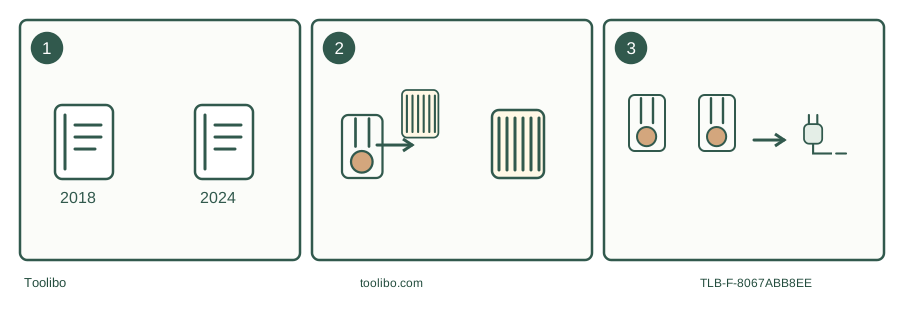
Match documents
Check the full model and manual revision before selecting a wet setup.
Read the cartridge rule
DXV06P 2018 separates liquid cases; DXV09P_2024 retains the cartridge.
Respond to the float
Both require stopping, unplugging and emptying when liquid closes airflow.
Revision-specific schematic; it is not a general DEWALT filter rule.
Similar-looking vacuums can have different wet rules
The US DEWALT DXV06P and DXV09P share familiar bucket-vac features, but their checked manuals do not give the same cartridge instruction for larger liquid jobs. That is the central comparison here. DXV06P is covered using the exact 2018 120 V manual; DXV09P is covered using the official DXV09P_2024 file. Neither scope includes a PL, QT or QTA suffix.
A model family name is not enough to select a procedure. Before buying consumables or borrowing a machine, compare the complete nameplate to the manual cover and check the wet-pickup section. If a newer supplied manual conflicts with an older online copy, resolve applicability instead of averaging the instructions into a new procedure.
What the size labels can tell you
DXV06P has a nominal 6-gallon drum and an 8 A rating in the checked US manual. DXV09P has a nominal 9-gallon drum and a 10 A rating. Both documents describe a 1-7/8-inch by 7-foot hose and a 10-foot cord. The listings use 4 and 5 peak-HP labels respectively.
These are identification and planning facts, not a demonstrated cleaning-performance hierarchy. Peak horsepower is not continuous motor output, and amperage alone does not tell you how well a nozzle collects a particular mess. Nominal gallons describe the tank rather than a guaranteed quantity of water before the float operates.
For a workshop with a narrow storage bay, check the actual external dimensions and access to the latches. For a spill-cleanup route, check where the machine can sit upright and where its drain can discharge safely. A larger tank may change how you batch a task, but cannot fix an awkward stairway or unsuitable receiving point.
The DXV06P revision separates liquid conditions
The matched 2018 DXV06P manual permits a clean cartridge for small liquid amounts, recommends removing the cartridge for larger amounts, and recommends a compatible foam filter when liquids contain debris. Dry-use filtering, including the disposable dry bag, must be removed for wet work. The cage and float remain.
This requires the owner to identify both the liquid and the current filter before starting. It also means an optional foam filter should not be assumed to be included in every box. Verify the exact consumable rather than purchasing an arbitrary foam sleeve that appears to fit.
The manual does not establish a numerical threshold between small and large liquid jobs. This comparison does not import a depth limit from another manufacturer. If the intended job is unclear, ask the manufacturer for the applicable setup instead of guessing based on the size of the puddle.
The DXV09P_2024 revision requires the cartridge
DXV09P_2024 says the cartridge must cover the cage during liquid pickup, and its maintenance section reinforces reinstalling it for wet and dry use. When repeated liquid collection saturates the cartridge and produces mist, the response is to stop and dry or replace it, not to adopt DXV06P’s larger-liquid removal instruction.
For an owner switching between these two machines, a storage note naming the model and wet setup can be useful. Put the reminder with the vacuum, not just on a shared filter box. The risk is not that the parts look completely different; it is that they look familiar enough for someone to repeat the wrong habit.
In neither machine is the float a substitute for electrical isolation. It closes airflow while the motor can remain energized. Lost suction and a higher-pitched sound require stopping, unplugging and emptying. Keep the cage and float intact regardless of cartridge configuration.
Buy for a repeatable workflow
For ordinary dry jobs, both need clean, intact, correctly sealed filtration and a clear hose. For suitable wet jobs, the difference in the documented cartridge process can matter more to daily ownership than the peak-HP labels. Consider whether you can readily inspect, change and completely dry the required media before the next task.
There is no tested winner here. Choose a machine whose exact instructions, replacement consumables, storage space and emptying route you can support. Do not infer quietness from the DEWALT colour scheme or assume suffix variants share these procedures.
Neither vacuum is presented as an approved hazardous-dust extractor. Do not collect flammable liquids, explosive dust, hot or smoking material, toxic substances or unidentified contamination. Waste disposal follows the contents, not the available drain fitting. Price, current inventory and long-term durability have not been assessed.
Models referenced