
The bottle mix and the final stream are different stages
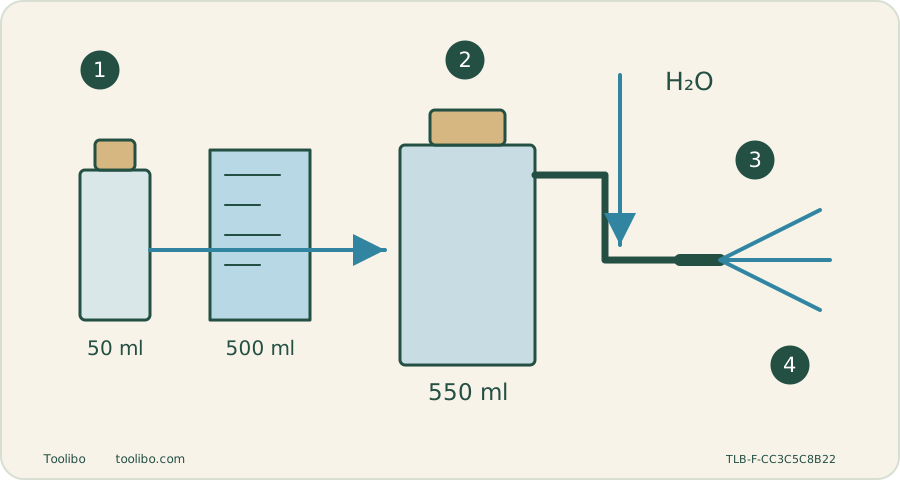
A measured product portion joins water in a bottle; a separate washer-water line enters a foam lance before the outlet, with both stages numbered.
Read
Identify the product and application mode.
Define
Distinguish water volume from final-mixture volume.
Measure
Use the explicit label convention and suitable equipment.
Separate
Do not equate bottle mix with final spray.
A second water stream can change concentration after the bottle; label wording controls the calculation.
Identify the product and application mode
Record the exact product, article number and current regional label. A shampoo may have different instructions for a hand bucket, a pump foam sprayer and a pressure-washer foam lance. Choosing the right product name is only the first step; select the instruction for the equipment actually in use.
Check compatibility with the washer’s detergent system and the surface. A foam lance attached after the pump is not the same arrangement as an onboard detergent tank or a feed through the pump. Do not transfer a recipe between them without explicit permission.
Read whether the instruction measures concentrate per litre of water, concentrate as a fraction of final mixture, or a defined product-to-water ratio. If a bare ratio does not define its convention, ask the manufacturer instead of silently deciding what the second number means.
Work through three different label examples
Swipe or scroll horizontally to see all columns.
| Hypothetical wording | What a 550 ml final batch would mean |
|---|---|
| One part product plus ten parts water | Eleven parts total: 50 ml product plus 500 ml water. |
| Product is 10% of final mixture | 55 ml product plus 495 ml water. |
| “1:10” without a defined convention | The correct quantities remain unconfirmed; obtain the label’s definition. |
All three rows are hypothetical label-reading examples, not SONAX dosing instructions. The difference matters: one part plus ten parts is not the same as ten percent of the final volume. Do not round these conventions into one shared recipe.
Choose measuring equipment suitable for the amount and cleaner. An unmarked bottle or a guessed capful makes it difficult to reproduce the batch or explain a poor result. Never reuse food or drink containers for chemical storage.
A precisely scoped product example
The SONAX PROFILINE ActiFoam Energy article 06183000 page specifies 15–25 ml of product per litre of water for a foam sprayer. For exactly 2 litres of water, that scales to 30–50 ml of product. The resulting liquid volume is greater than 2 litres; this is not a two-litre final-volume recipe.
The same page gives a separate foam-lance ratio range of 1:10–1:20 and a different manual-wash instruction. The foam-sprayer dose should not be pasted into those other modes. Where the ratio convention is not explicit, this guide does not resolve it by assumption.
The product also excludes use on hot surfaces and drying on the surface. Correct arithmetic cannot compensate for unsuitable application conditions.
Understand the second dilution point
A foam-lance bottle may hold a premix. The lance can then introduce that mixture into a separate water stream from the washer. The bottle concentration therefore does not automatically equal the concentration on the panel.
A knob position is not a calibrated percentage unless the maker supplies an applicable calibration. Changes in equipment or operating conditions can affect draw. Likewise, thick foam is a visual result, not proof of the cleaner’s concentration, compatibility or cleaning power.
Do not compensate for weak foam by arbitrarily increasing chemical strength. Check the approved setup, product instructions and draw system first. If the detergent is not being drawn, use the external diagnosis route rather than changing internal parts.
Make a repeatable batch record
- Write the exact product, application mode and label wording.
- State whether the measured water or the final mixture is the reference volume.
- Calculate and measure the quantities within the permitted range, using the label’s mixing order and handling precautions.
- Label the batch and use only the approved equipment; keep incompatible products separate.
- Apply under suitable conditions, remove residue as directed and record the observable result without inventing a panel concentration.
If cleaning is poor, note whether dirt remained, foam was absent or residue dried. Those are different problems with different next steps. A useful record says what was actually measured and done, not simply “strong foam setting.”