
Choose the job, supply and working route
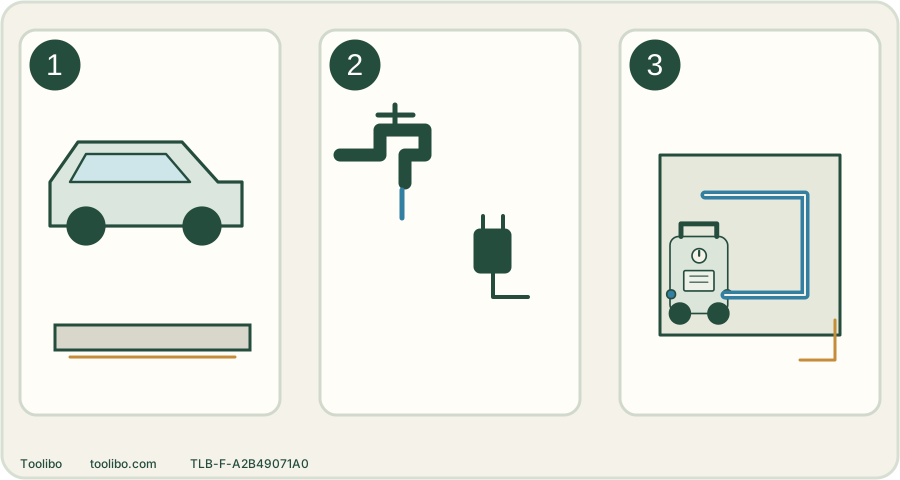
Three household cleaning tasks connected to a water tap, a pressure washer and a measured hose route around a car.
Task
Choose the surfaces and frequency that justify owning the tool.
Supply
Check water delivery and a suitable electrical connection before choosing a machine.
Reach
Measure the usable route and storage space, then compare complete kits.
The useful working distance follows the hose route around obstacles; it is not a circle drawn from the tap. Conceptual schematic, not a product image or scale drawing.
Write down three real jobs
List the surfaces, approximate area and frequency of your normal cleaning. A few pressure-washable garden chairs are a different workload from a car and a long paved path. Check the object maker before adding a bicycle: Trek prohibits high-pressure washing, so use its approved gentle hand-cleaning method instead. Peeling paint, loose mortar and weathered timber are not problems extra pressure automatically solves; they may rule out pressure washing or require a gentler method.
Next identify the most awkward regular job, not a hypothetical annual task that would justify the largest machine. If broad paving is the main job, a compatible surface cleaner and sufficient water flow may matter more than an impressive peak pressure. If small objects dominate, storage and carrying convenience deserve more weight.
Check the site before the specification sheet
Find the usable water tap, safe electrical supply and drainage route. Measure the hose route around obstacles rather than the straight-line distance. The water hose from tap to machine and the high-pressure hose from machine to gun do different jobs; neither length replaces the other. Leave enough freedom to work without dragging the machine by its hose.
Compare the manufacturer’s minimum inlet flow with the supply available at the end of the intended garden hose. An adequate tap with a long, kinked or restricted hose can still be an inadequate supply at the machine. Water delivery must stay consistent while the trigger is held. Also check permitted inlet temperature and the local requirements for a backflow preventer; an ordinary connector does not establish compliant drinking-water protection.
Compare figures with the same meaning
Put maximum pressure beside maximum pressure, rated pressure beside rated pressure, and flow figures with the same label and units beside each other. Do not multiply a maximum pressure by a separately published maximum flow and call the result measured cleaning power. Those maxima do not establish a simultaneous operating point.
For example, Bosch’s UK EasyAquatak 120 and UniversalAquatak 135 product pages advertise different maximum pressure and flow values, while their manuals publish lower rated operating values. Neither discrepancy means the motor is faulty. The label on the figure tells you what comparison is valid.
Price the kit that will actually be used
Make four lines in the budget: machine and supplied gun/lance; any necessary supply fittings; the task-specific accessory; replacement or storage items. Check whether a detergent bottle, surface cleaner or suction hose is supplied, optional or incompatible. A photograph showing an accessory is not a packing list.
A longer factory hose can avoid repeated repositioning, but buying unapproved extensions is not a sound substitute. Check exact model compatibility and the permitted extension arrangement. Avoid paying for several bundled brushes if the only accessory you need is a correctly matched patio cleaner.
Choose between two credible candidates
Use a short trial plan on paper: carry each machine from storage, connect the supply, reach the far side of the car or path, then drain and store it. Reject the candidate that cannot fit your supply or storage constraints before comparing optional features. Among the remaining choices, pay for a useful difference such as reach or the right accessory, not a pressure number alone.
Two illustrative households
Consider a hypothetical small courtyard: suitable chairs are cleaned beside the tap, the measured route fits within 5 m and storage is limited. An EasyAquatak 120 configuration belongs on the initial shortlist; paying for a 7 m hose has no demonstrated benefit in this layout. Confirm its inlet requirement and attachments before buying. If the main object instead prohibits pressure washing, a smaller pressure washer does not remove that prohibition.
Now consider a household regularly washing a car and several outdoor objects. The measured hose route fits 7 m but not 5 m, and the supply reliably meets the UniversalAquatak 135 requirement. That model becomes a stronger shortlist because it avoids a regular move. If the main task is broad paving, add the cost and compatibility of a surface cleaner before choosing. These are worked selection examples, not measured results or a universal recommendation.
Record the exact product code, market and included kit when you decide. The same family name can cover different hoses, guns, electrical versions and detergent systems. This gives you a reliable basis for buying consumables and following the correct instructions later.