
Cooling does not erase the cause of loading
A stopped loaded joint with heat marks, a separate cooling space and a recorded joint problem show why a pause alone is not a repair.
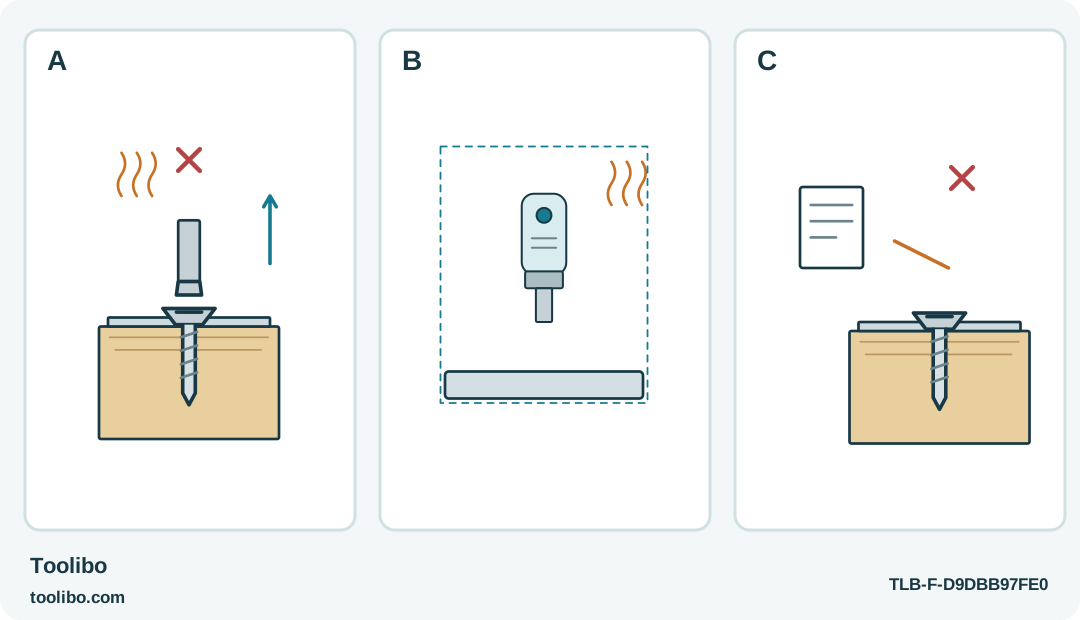
A
Release the control and stop loading the reluctant screw; do not touch a hot bit to judge temperature.
B
Let an undamaged tool cool naturally in suitable dry conditions; do not force cooling or reconnect an abnormally hot tool.
C
Understand and remove the load cause before any further permitted use. Recurring heat or distress ends testing.
A cooling pause removes neither a blocked fastening nor a recurring fault; the cause of the load must be understood before further use.
Stop the work before diagnosing the temperature
A compact driver that becomes unusually hot during a small fastening job should not be kept running to see whether it improves. Release the control, keep the rotating end clear and let the tool stop. Put the work into a safe, supported state before concentrating on the driver. Do not touch a hot bit or grasp the front end to judge its temperature.
This guide concerns the WORX WX252L and English-export VESSEL 220USB-1E. It does not provide a universal surface-temperature limit or a method for testing a battery. Heat, smell, smoke, swelling or visible damage can change the situation from an interrupted job to a serious hazard. Do not continue handling or charging a visibly failing tool to complete a checklist; keep people clear and obtain appropriate emergency help if there is an immediate danger.
Reconstruct the last few actions
Ask what the tool was doing before it became hot. Was it running for a prolonged period under heavy resistance, repeatedly stopping against a stubborn screw, or being held at low speed while the fastener barely moved? Those observations can reveal an unsuitable task even when the tool itself has no obvious external damage.
The WX252L specifically warns against prolonged low-speed operation because it produces internal heat. Slow movement is therefore not automatically gentle work. The VESSEL can activate protection under excessive loading, and its guidance calls for a longer pause rather than repeated attempts to defeat the stop. Neither behavior justifies forcing the same reluctant screw with more pressure.
Separate the joint problem from the tool
Inspect the stopped, supported fastening without keeping the driver engaged. A wrong screw, a blocked path, a damaged recess or a misaligned fitting can create sustained resistance. If the screw is seized, structurally important or part of electrical equipment, this household check is not the right procedure.
Correct only a clearly identified, ordinary external setup problem. Do not automatically replace a screw with a longer one or enlarge a hole simply to reduce the load. Follow the furniture maker’s fastening method, and choose a suitable hand tool or a different approved process when the powered driver is not appropriate. A pause does not turn an unsuitable job into a suitable one.
Let the tool recover naturally
Allow the tool and any hot accessory to cool in a suitable dry location under the manufacturer’s conditions. Keep it away from children, loose hardware and direct heat. Do not immerse it, place it in a freezer, spray liquid through the vents or use compressed cooling products to speed the process.
Do not open the housing or remove an integrated cell. A protection stop is not an instruction to bridge contacts or connect an external power source. On the VESSEL, release the switch rather than repeatedly pressing it after an automatic stop. If normal operation does not return under the specified conditions, or unusual heat recurs during an appropriate light task, stop testing and seek service.
Keep charging observations separate
Some warmth during an ordinary charging cycle may be described in a tool’s instructions, but that does not explain every hot housing. Use only the specified charging arrangement and suitable ambient conditions. Do not connect a tool that is damaged, abnormally hot or showing battery distress merely because the motor no longer runs.
If unusual heat develops during charging, discontinue the charging attempt using a safe disconnection method if it can be done without approaching an immediate hazard. Do not keep reconnecting the charger to compare results. Record the tool and supply identities and what the indicator showed, then use the manufacturer’s support route. Charging warmth and heavy-load heating are different observations, not interchangeable diagnoses.
Decide what must change before another job
A return to a cool surface is only one condition for considering further use. The tool must be undamaged, its controls reliable and the original cause of excessive loading understood and removed. Begin no further test if those conditions are uncertain. A short rest is not evidence that an internal fault has disappeared.
Keep a note of the fastener, material and behavior that led to the interruption. That helps distinguish a one-off unsuitable job from repeated tool trouble when discussing service. The aim is not to learn how much heat the driver can tolerate. It is to recognize when the task, setup or tool needs a different decision before anyone presses the control again.
Models referenced