
Make accidental contact impossible in the organizer
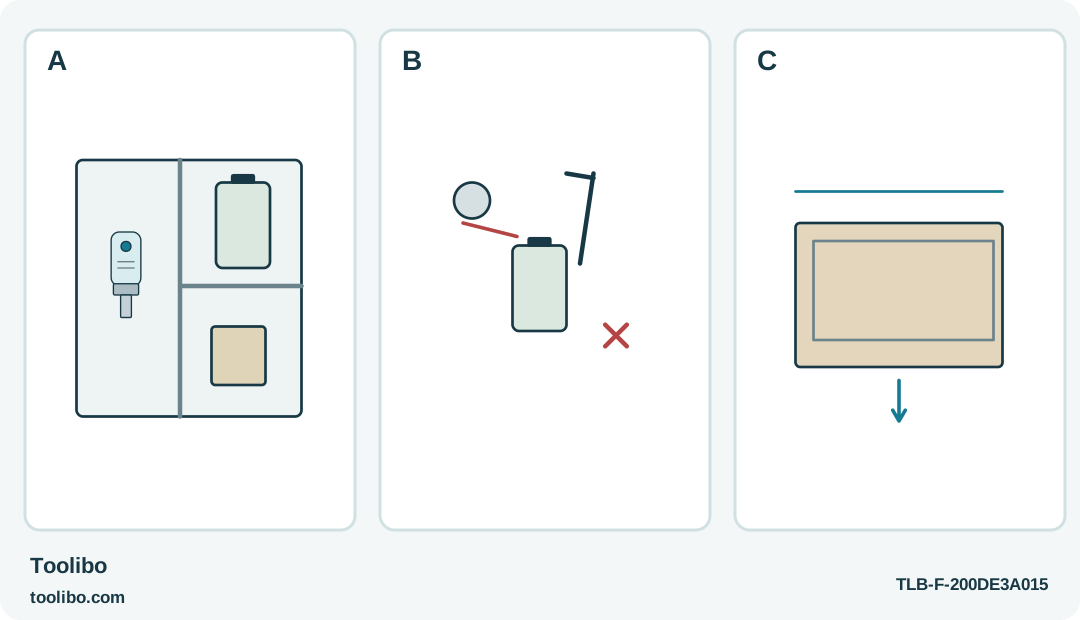
A partitioned organizer, excluded metal near a separate battery and a drawer movement check explain storage separation.
A
Lock, remove the correct battery as instructed and use stable separate spaces for tool, pack and hardware.
B
Keep conductive objects away from pack contacts; a loosely divided pile is not protected storage.
C
Check that opening the drawer cannot shift trays or pinch an unplugged charging lead. Store out of children’s reach.
Separate spaces must remain separate when the drawer moves, with battery contacts protected from the loose hardware stored nearby.
Design the drawer around accidental contact
A drawer full of spare screws is a convenient place to lose a compact driver, but it creates several avoidable problems. A hard object can press a control, a loose bit can damage a finish or cable, and metal pieces can bridge exposed battery contacts. Storage is therefore more than finding an empty corner after the job.
This arrangement is for the Makita DF012D and Milwaukee M4 2101-20 with their correct removable batteries. It does not authorize opening a battery, modifying a pack or transferring one brand’s charging procedure to the other. Begin with a cool, dry, undamaged tool whose work is complete and whose controls operate normally.
Finish the operating sequence first
Release the control and wait until the bit stops. On the Makita, set the lock lever to B when the tool is not operating. On the Milwaukee, set the lock switch to its locked position. Remove the battery according to the exact tool’s procedure before accessory changes and storage preparation.
The M4 battery is retained by its own insertion-and-rotation arrangement; it is not an M12 pack. The DF012D uses its specified Makita battery system. Do not force either pack or improvise a latch because another removable battery seems to fit the opening. If retention is damaged or removal is abnormal, stop and seek the appropriate service advice.
Give batteries a separate protected place
Keep removed packs away from screws, coins, keys, paper clips and other conductive objects. Use suitable individual storage that protects contacts without placing metal across them or applying pressure to them. A compartment is useful only if loose hardware cannot spill into it when the drawer is opened.
Do not store a damaged pack with sound equipment or charge it merely to see whether it recovers. Mark a suspect item clearly and follow the manufacturer’s service or disposal guidance. Avoid storage in direct heat, wet conditions or other places outside the permitted conditions. A car left in the sun is not a substitute for a suitable indoor storage location.
Sort accessories so they stay identifiable
Remove and inspect the bit when it is safe and cool to do so. Put usable bits in a holder or labeled compartment where their tips cannot press switches or scratch battery contacts. Separate worn or twisted bits rather than returning them to the same row as sound ones.
Keep remaining furniture screws with the instructions or a clear label describing the project. Mixing nearly identical lengths can cause a problem at the next repair, especially when a longer screw could emerge through a thin panel. Storage that preserves fastener identity is part of preserving the successful assembly, not merely a matter of tidiness.
Rehearse the drawer movement
Before storing everything permanently, close and reopen the empty or lightly loaded drawer and notice which compartments shift. A loose tray that slides over the tool can defeat an otherwise sensible layout. Add a stable organizer suited to the drawer rather than packing objects tightly against the driver to hold it in place.
Keep the charging equipment identified separately from loose fasteners. Route an unplugged lead so it will not be pinched by the drawer edge. Do not leave a charging setup buried under packaging or treat storage as an unattended experiment with an unknown charger. Follow the normal charging procedure in a suitable location before returning the equipment to storage.
Make the next start a deliberate one
Store the tool out of children’s reach and where an unfamiliar user will not mistake a tagged faulty item for a ready tool. A brief note about an unresolved control, holder or battery issue is worth more than a clean-looking case. Do not rely on a discharged battery to communicate that a tool should not be used.
At the next job, take out the tool and correct battery separately, inspect their condition and fit the proper accessory before restoring power. That small separation makes setup intentional. The goal is a drawer in which no loose object can become an unintended connection, an accidental trigger finger or a misleading substitute for the correct screw.
Models referenced