
A fitting plug answers only one question
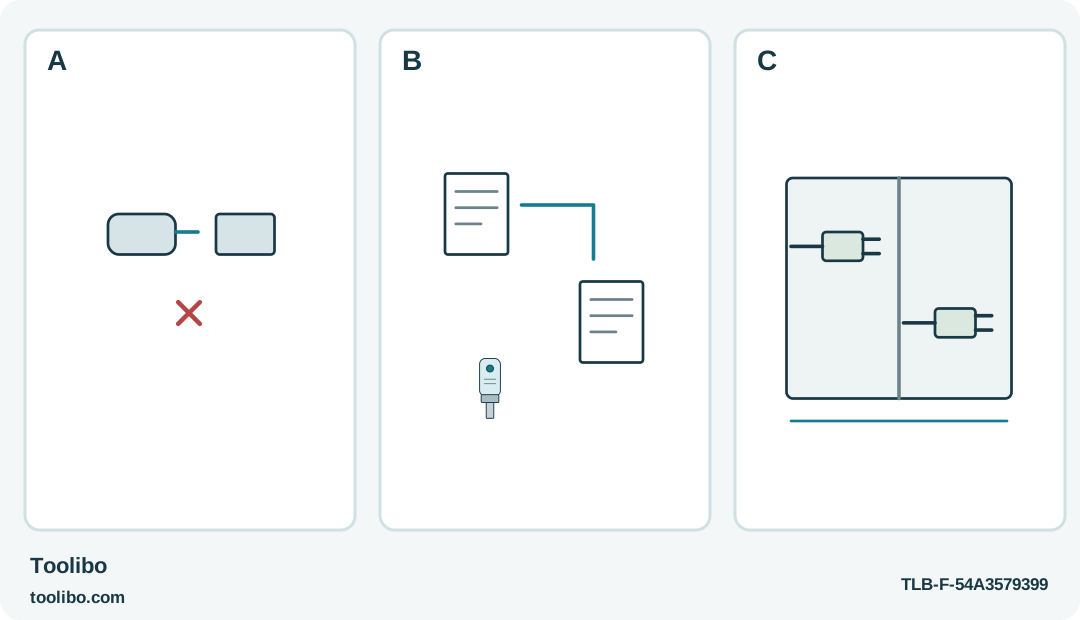
Two connector silhouettes with a crossed equivalence cue, linked identity records and separated charging spaces distinguish mechanical fit from a complete charging system.
A
Connector form does not establish supply compatibility; do not improvise adapters.
B
Match the exact model, region and charging requirement together, rather than borrowing another tool’s specifications.
C
Keep identified charging systems in an uncluttered dry area, leads protected and loose hardware separate.
Mechanical connector fit is only one feature of a charging system; the model, supply requirement and complete equipment must agree.
Split one familiar word into three questions
“USB screwdriver” sounds like a complete charging description, but it leaves important questions unanswered. Which connector is on the tool? What supply and cable does that exact model require? What operating and battery-care restrictions apply while it is connected? Answer those questions separately before sharing equipment between drivers.
The WORX WX240L, Bosch IXO7 sold under the identified UAE listing and English-export VESSEL 220USB-1E illustrate why. They are small integrated-battery tools, but that does not make every lead, adapter or charging instruction transferable between them. This guide is about choosing and organizing the correct equipment, not modifying a charger or diagnosing its internal electronics.
Identify the tool before selecting the cable
Read the actual model and regional identity, then locate its supplied charging instructions. Similar product names can span generations with different connectors or battery arrangements. The IXO7 is not an instruction source for the newer IXO8, and the export VESSEL 220USB-1E must not be treated as the US 220USB-1U merely because the bodies look related.
Keep the tool’s instructions and approved equipment identified together. If several family members share a drawer, label the storage position rather than relying on the color of a cable. An unlabelled lead that happens to fit is not enough information to decide that it belongs with a particular driver.
Match the electrical requirement as well
For the exact US WX240L and 220USB-1E, the charging guidance specifies an appropriate 5 V, 1 A supply arrangement. Check the actual manufacturer’s instructions and equipment labels before using that information; it is not a rule for all compact screwdrivers. Use the specified Bosch arrangement for the IXO7 rather than borrowing a voltage or charging-time claim from another tool.
Do not alter a plug, splice a cable or add an improvised power adapter to make a mismatched system connect. A device that does not charge through an unknown combination is not proof that the battery needs more voltage. Resolve the equipment identity first, especially when the original charger or cable has been lost.
Plan a simple charging station
Choose a dry, uncluttered location within the tool’s permitted charging conditions. Keep screws, coins and other metal items out of the area, and route the lead so it will not be pinched by a drawer or pulled by someone passing. Do not cover the tool or charger with assembly packaging.
Place each tool with its own identified equipment and leave its controls in the normal safe position. Check for cable damage, a deformed connector or unusual heat before continuing. Do not probe a charging socket with a metal object to clear it, and do not leave a damaged tool connected as an experiment to see whether an indicator eventually appears.
Keep charging and working separate
The IXO7 and VESSEL instructions describe no operation while charging; a connected tool that will not run is therefore not necessarily faulty. Follow the charging procedure, disconnect as instructed and only then prepare for ordinary use. Do not pull on a lead to extend the tool’s working reach or treat the charger as a permanent operating supply.
Interpret indicators using the exact model’s instructions. A red or green light is not a universal language across brands, and a claimed charging duration on one listing should not become a timer for all three tools. If the supplied instructions are missing or contradictory, seek clarification rather than choosing an arbitrary long charging period.
Choose convenience without losing traceability
A shared charging location can be useful, but sharing unidentified equipment is a different decision. When comparing a replacement tool, consider whether its approved cable and supply will be easy to keep with it, whether you can read the indicator clearly and how the manufacturer handles a failed integrated battery.
Do not open the battery housing to make a convenient connector work, and do not assume a newer generation’s replacement-battery procedure applies to an older sealed model. Good organization leaves you able to name the tool, its approved supply and the normal charging indication without guessing. That is a more reliable convenience than having a drawer full of plugs that almost match.
Models referenced