
Hand finishing is not extra leverage for a fault
A separate neutral hand-turn arc, a crossed extension sleeve and a cracked joint distinguish permitted finishing from excessive force.
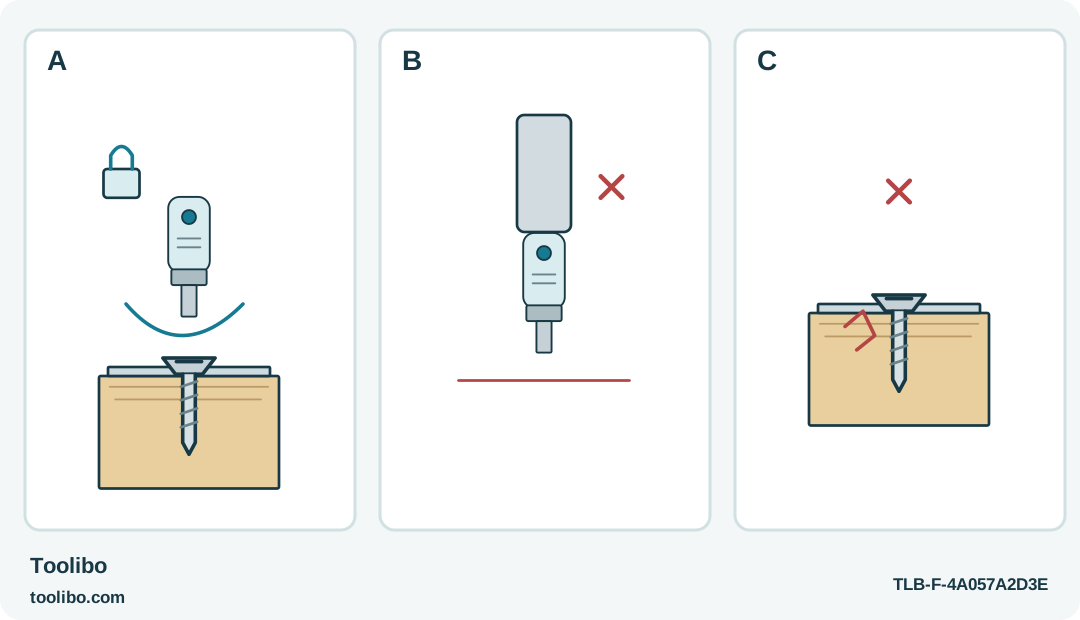
A
Stop the motor, neutralize or lock as instructed and make only a permitted gentle final adjustment on a sound joint.
B
Do not add a tube, pliers or impacts. A manual-use ceiling is a boundary, not a target to estimate by feel.
C
Stop at damaged material, slipping or unexpected resistance; a spindle lock does not repair the joint.
Manual finishing remains a controlled final adjustment on a sound joint, not extra leverage for a seized screw or damaged material.
Ask why the powered stage has ended
Hand finishing can be useful when a joint’s instructions call for a small, controlled final adjustment. It is a different situation when the motor has stopped because the screw is jammed, the bit is slipping or the material has failed. Before turning the handle by hand, decide which of those situations you are in.
This guide concerns the Makita DF012D and English-export VESSEL 220USB-1E on ordinary, accessible household fasteners. It is not a removal method for rusted screws, a structural tightening procedure or a way to meet a calibrated torque specification. If the fitting maker requires a particular hand tool or final method, use that requirement rather than substituting the powered driver’s body.
Make the motor-to-hand transition explicit
Release the operating control and wait for rotation to stop. On the VESSEL, keep the slide in neutral before turning the handle manually. Never operate its motor while manually turning the locked spindle. On the Makita, switch off and use the lock lever B as instructed when the tool is not operating.
Do not begin a wrist turn while the bit is still rotating or while your finger remains poised to restart it. Reposition your grip with the tool stopped and the work supported. If that transition is awkward in the available space, remove the driver and use a suitable ordinary hand screwdriver rather than combining powered and manual movement.
Check that the joint is worth finishing
A suitable joint has the correct screw, sound material, a properly aligned fitting and a clearly understood seating condition. The final movement should be small and deliberate. A screw that remains far from its seat, turns without gripping or needs unexpectedly heavy force has not earned a manual finishing step simply because powered travel is over.
Look at the recess and bit before continuing. A damaged tip or rounded head can slip under hand force as well as under power. Keep hands clear of the path the tool would take if it slipped, and do not support a thin panel directly behind a screw that could emerge. Wear eye protection during the fastening task.
Treat the tool’s limit as a boundary
The DF012D’s hand-driving guidance includes a limit below 5 N·m and excludes excessive work such as rusted-screw removal. The VESSEL manual gives its own manual maximum. Those are limits of tool use, not suggested torque settings for furniture. Do not aim at either number by feel, compare them as a measure of joint quality or assume a handle can safely deliver more with an extension.
Never add a tube, clamp pliers onto the body or strike the tool to increase leverage. Do not use the driver as a pry bar to align the fitting while twisting. If gentle permitted hand movement will not achieve the specified seat, stop and investigate the fastening rather than treating the spindle lock as a stronger motor.
Make one deliberate adjustment and inspect
Keep the fitting supported and turn only as the joint’s instructions allow. Pause to inspect the head, surrounding surface and part alignment. The useful feedback is a correctly seated, undistorted fitting, not the maximum resistance your wrist can overcome. Stop immediately if the recess deforms, the material cracks or the screw begins to spin without tightening.
Do not repeatedly alternate motor bursts and heavy hand turns to force a reluctant fastener. That can hide the original cause of resistance and damage both the joint and tool. If a torque-controlled powered trial is appropriate, return to a matching sample and a sound setup; do not continue experimenting on the damaged real component.
Choose a different method when the boundary is reached
A separate correctly fitting hand screwdriver may offer better access or control, but it does not remove the need to diagnose a stuck or damaged screw. Seized fasteners and failed holes require an appropriate repair method rather than more leverage from whichever handle is nearby.
After the task, leave the control locked or neutral and store the tool with sound accessories. Keep any note about the successful joint method with the remaining hardware. Hand finishing is useful when it is the planned final action in a sound assembly. It should not become the unplanned answer to every stop, stall or uncertain resistance.
Models referenced