
Different ways to reach a neutral handoff
Separate slide-release and axial-release panels lead to a distinct hand-turn arc; a crossed activation cue excludes simultaneous power.
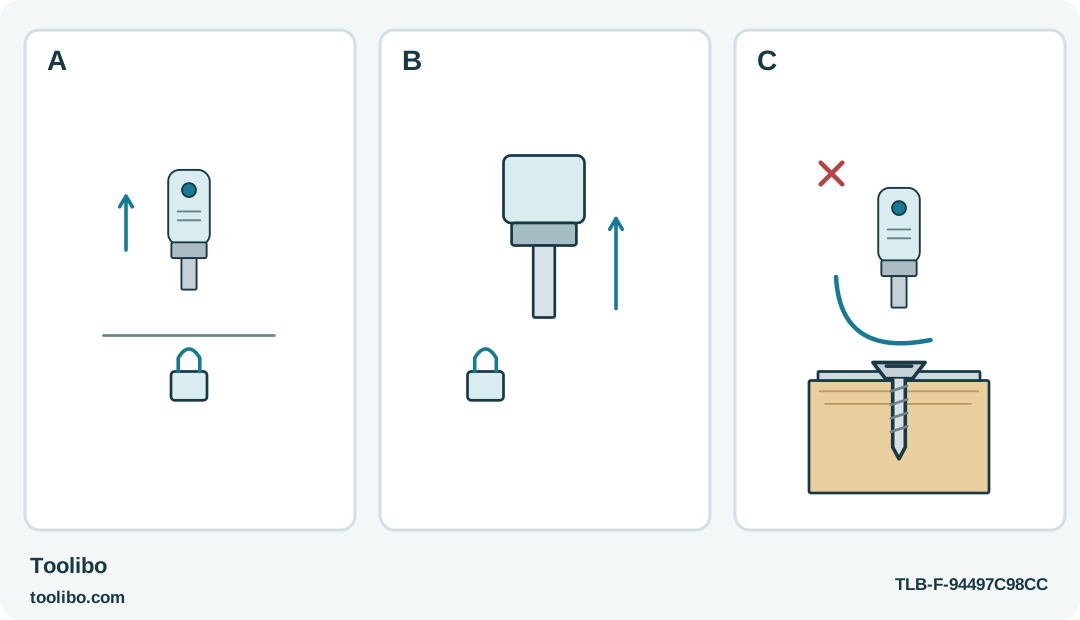
A
Release the VESSEL slide and wait for the motor to stop; keep the control neutral.
B
Remove axial pressure from PushDrive, wait for stopping and use its middle-lock.
C
Only then use a permitted gentle hand finish. A wrist turn must not overlap powered movement.
The route to a safe hand finish differs, but both routes require powered movement to end before the wrist starts turning the tool.
Start with the handoff, not the handle shape
Two compact drivers can both be useful for running a screw through its easy travel yet feel quite different at the last turn. The important distinction is how you leave powered operation. With the English-export VESSEL 220USB-1E, you release its sliding switch before turning the handle manually. With the British Bosch PushDrive, axial pressure starts the motor, so a deliberate move to the middle-lock position separates hand driving from pressure activation.
Consider an ordinary furniture fitting whose maker permits hand finishing. The fitting must already be aligned, supported and using the specified screw. Neither design makes a damaged hole recover its grip, and neither should be chosen to break loose a seized screw. Exclude electrical equipment and safety-critical assemblies from this comparison.
How each control changes the sequence
The VESSEL slide switch returns to neutral when released. At the end of powered travel, release it, let rotation stop and keep your finger away from the switch before making a gentle manual adjustment. Do not slide the switch while your wrist is turning the locked spindle. Combining those actions is not a faster finishing technique.
PushDrive needs a different habit. Simply relaxing pressure stops powered rotation, but the selector should then be moved to its middle position for manual use. That prevents the next axial push from restarting the motor. Anyone accustomed to squeezing a conventional trigger should rehearse this distinction on the stopped tool before approaching a delicate finish.
Compare the bit system as well
A comfortable handle is irrelevant if the chosen bit does not fit the holder properly. The 220USB-1E accepts specified mounting dimensions; the quarter-inch description alone does not prove that a bit from another regional VESSEL set is suitable. Follow the sleeve-and-retention check for the actual export model rather than borrowing instructions for the US 220USB-1U.
PushDrive also has accessory limits, including its restriction on longer two-sided screwdriver blades. Check the complete blade geometry and the tool’s instructions before use. A bit that slips out, cannot seat fully or rocks in the holder is not ready for a trial. Never hold an insecure bit in place with a finger while running the motor.
Try a complete fastening cycle
Use matching spare material and the same screw arrangement as the intended ordinary joint. Secure the sample, wear eye protection and keep fingers away from the bit and possible screw exit. Identify the intended seating condition before starting; a head resting on a bracket is different from one driven below a soft surface.
Run the easy portion cautiously, then stop before the final seat. On VESSEL, release the slide completely. On PushDrive, remove axial pressure and set middle-lock after rotation stops. Check the fitting, then make only the small manual adjustment the joint actually requires. If resistance rises unexpectedly, stop instead of adding leverage. The result to inspect is the joint, not how firmly your hand can twist the handle.
Which arrangement fits your habits?
A user who likes a clearly separate finger command may prefer the VESSEL slide-to-run sequence. Someone who wants pressure-start operation may find PushDrive convenient, provided the neutral-lock step becomes deliberate and consistent. Neither preference establishes better fastening accuracy for every user, and a brief comparison should not be mistaken for measured performance testing.
Try the grip with the motor stopped in the access space you actually have. Your wrist needs room to turn without colliding with a cabinet edge. If the manual finish requires an awkward bend or loss of grip, a correctly fitting ordinary hand screwdriver may be the better final tool. A powered body should not be forced into a space merely to avoid changing tools.
Keep the finishing limit visible
Manufacturer manual-driving limits are ceilings, not recommended furniture settings. They do not override a fitting maker’s instructions or authorize extension tubes, pliers on the handle or repeated force against a reluctant screw. Stop if the recess begins to deform, the material cracks or the screw turns without tightening.
Store the selected tool with its control neutral and its charging lead disconnected after the charging procedure is complete. Keep the compatible bit identified alongside it. The practical benefit of either design is a controlled transition between two distinct actions: powered travel and a modest, observable manual finish. If that transition is unclear, practice on the sample again rather than discovering the control behavior on a finished panel.
Models referenced