
Transport checks and collection checks stay separate
Original drawing separates a modular base lock from the tank, filter and float checks, with a two-position control beside the vacuum.
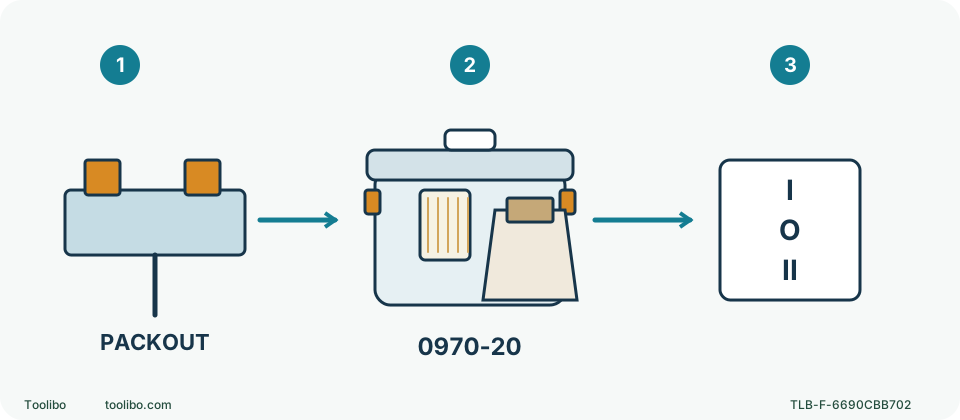
Place
Verify a stable permitted arrangement.
Configure
Check filter, bag and float for this task.
Control
Choose the mode without masking a fault.
PACKOUT connection, dry/wet configuration and operating mode are independent checks; the drawing is not a load-rating chart.
Start with what is different about this model
The US 0970-20 is the M18 FUEL PACKOUT compact wet/dry vacuum with a 2.5-gallon nominal tank and a High/Low switch. The product listing gives 50 CFM airflow and 47 inH2O suction. These separate published values are not a measured promise about the hose end during your job. Nor does the manufacturer’s comparative suction advertising establish a Toolibo test result.
PACKOUT compatibility can reduce the number of separate items carried to a task, but it is a storage and movement feature. A latched stack tells you nothing about whether a filter is installed or a bag is appropriate. Treat transport readiness and vacuum readiness as two checklists, especially when somebody else assembled the equipment.
Make the parked arrangement workable
Put the machine on a stable arrangement permitted by the relevant storage instructions, with clear access to its switch, battery compartment and tank latches. Think through where the hose will travel before switching on. If reaching the far side of the work would pull across the stack, move or separate the equipment while it is stopped instead of relying on the locks to resist the pull.
Do not infer that a rolling arrangement may be lifted by the vacuum handle, used as a step or loaded without a limit because the components connect. The applicable base and storage modules have their own instructions. If you cannot verify the arrangement, use the vacuum separately on a stable surface. Keep the collection tank upright; modular storage does not remove that operating requirement.
Keep dry collection components distinct
With the battery removed, inspect the tank and intake, fit the specified dry filter and close the head securely. The 49-90-2016 fleece bag is listed for this model, and the manual shows its cardboard inlet engaging the bag holder. The bag is a collection aid, not a replacement for the required filter or a certificate that the material is safe to collect.
Avoid creating a compatibility chain from appearance: a bag that fits 0970-20 is not automatically listed for 0880-20, despite the two machines sharing 49-90-1900 filters. Check the bag collar’s seating before closing the tank; a pinched or displaced collar can defeat the intended collection path. Never add tape or cut the holder to make a doubtful part fit.
Give wet pickup its own preparation step
The matched manual instructs removal of the dry filter for wet collection and retention of the float cage; it recommends wet foam 49-90-2015. Empty dry contents first and remove dry collection layers before configuring the machine for the permitted liquid task. Confirm the float is clean and can move as intended. If its action is doubtful, repair is needed before wet use.
Swipe or scroll horizontally to see all columns.
| Change | Check with the battery removed | Stop condition |
|---|---|---|
| Dry to wet | Empty tank; change from dry filtration as instructed | Unknown liquid or damaged float |
| Wet to dry | Clean, dry and refit correct dry collection setup | Damp or damaged dry media |
| Separate to stacked | Confirm stable, permitted mounting and access | Unverified module/load arrangement |
| Low to High | Use the intended switch positions | Poor pickup caused by a blockage or fault |
Use the controls without masking a problem
Low and High let you select the documented operating mode; they do not diagnose the cause of poor pickup. If performance changes unexpectedly, first stop and distinguish a collection limit, restriction, battery issue or other fault. Simply moving to High can conceal the observation you needed to make and cannot repair a split hose or badly seated filter.
During liquid work, a higher motor pitch and markedly reduced suction require immediate shutdown. The float closes the air route rather than providing a safe substitute for switching off. Remove the battery before emptying. Never defeat the float to use the last visible space in a nominal 2.5-gallon tank. Treat spills at the motor head or repeated abnormal behavior as reasons to stop and obtain service.
Finish as a cleaning task, not just a storage task
Empty and clean the permitted contents and components, dry them appropriately and inspect the collection setup before the next job. Do not latch damp equipment into a closed storage arrangement merely because the outside looks tidy. Remove the battery for storage and secure the hose so it cannot snag a door or another module.
For ordinary household use, this model is worth considering when the documented controls and compatible modular arrangement solve a real workflow problem. A tool adapter, HEPA label or a manufacturer reference to selected silica applications does not authorize an unspecified hazardous-dust job. That separate assessment must match the material, tool, controls and jurisdiction; this guide does not provide it.
Models referenced