
Three components, three different jobs
Original exploded schematic separates the dry cartridge, wet foam and retained float cage, with a crossed link to an unlisted fleece bag.
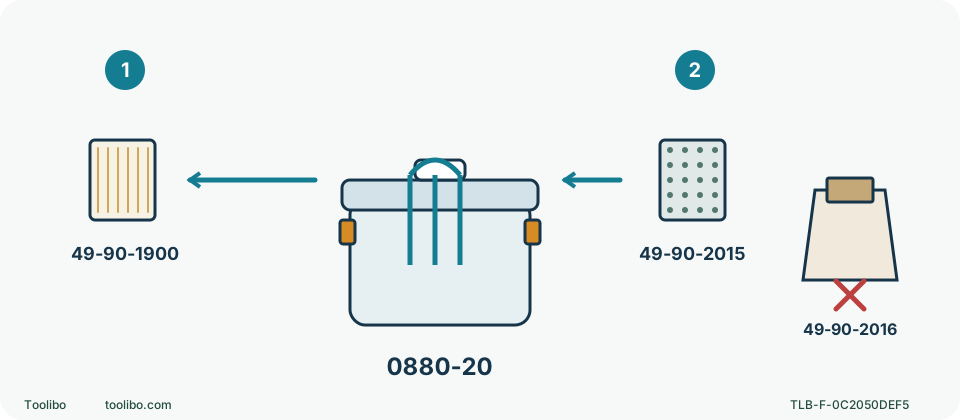
Dry
Install the specified dry filter.
Wet
Follow the wet changeover and retain the float cage.
Match
Check bag compatibility separately.
The dry filter, foam and float cage are not interchangeable; the bag requires a separate model compatibility check.
Identify the current configuration, not just the case shape
This guide covers US 0880-20 with the M18-only manual 58-14-0074d3. The product page also offers other document revisions, so keep the actual machine’s label and supplied instructions together. Do not use an old combined-model manual to assume another battery family fits the unit in front of you. The compact toolbox-like shape is useful for storage, but it does not establish PACKOUT attachment compatibility.
The published specifications include a 2-gallon tank, 45 CFM airflow and 32 inH2O suction. These are different measurements, not three versions of “power.” In particular, do not multiply airflow by sealed suction as if both maxima occur at the same working nozzle condition. For a household buyer, the more immediate question is whether the nozzle, reach and collection space suit the task.
Make a dry setup that is easy to inspect
Set the switch off and remove the battery before opening the tank. Check the accessible intake, tank seating and hose for obstruction or damage. Fit the correct dry filter securely, then close both tank latches. Keep accessories out of the collection path rather than leaving them loose inside a tank that is about to be used.
The listed 49-90-1900 filter is also used on other Milwaukee compact vacuums. That shared part does not make their entire collection systems interchangeable. In particular, the 49-90-2016 fleece-bag page lists 0960-20 and 0970-20, not 0880-20. Do not cut a hole or attach a homemade holder to imitate the other machine’s bag arrangement.
Plan the wet configuration before reaching the spill
The matched manual requires removing the dry filter for wet pickup while retaining the float cage. Milwaukee separately lists the 49-90-2015 foam wet filter as compatible with 0880-20. Use only the configuration and accessory instructions matched to the actual unit; foam is not a substitute for the dry HEPA filter when returning to dust.
Empty the dry debris first, choose a stable upright position and keep the battery handling area dry. Limit the work to a known, permitted liquid in an electrically safe setting. The absence of a mains cord does not authorize floodwater, sewage or liquid whose composition is unknown. Identify the disposal route before starting so the collection does not become a second problem.
Swipe or scroll horizontally to see all columns.
| Component or feature | What it establishes | What it does not establish |
|---|---|---|
| 49-90-1900 | A specified dry filter match | Compatibility of every bag or tank |
| 49-90-2015 | A listed wet foam option | Permission to use foam for dry hazardous dust |
| Float cage | Part of the liquid cutoff system | Automatic electrical isolation |
| Toolbox shape | Compact storage arrangement | A PACKOUT locking interface |
Recognize a full-tank stop without testing the limit
In liquid collection, a rise in motor pitch with sharply reduced pickup is a stop signal. The float closes the suction route; the motor is not thereby proven switched off. Stop immediately, remove the battery and deal with the collection load. Never tie the float out of the way to obtain more volume.
A tipped machine can also lose suction. Stop it before restoring its position, then inspect for spills or damage. Do not shake or swing a running machine to reset anything. If the cause is uncertain, the float does not move correctly, or the machine behaves abnormally again, stop the task and arrange service. A familiar sound from a previous job is not a reliable diagnosis.
Return it to dry use deliberately
After wet work, empty and clean the permitted components and allow them to dry properly. Refit the correct dry filter before the next dry task. Check the filter seating and the tank seal instead of merely noticing that the lid closes. A wet storage compartment, kinked hose or damaged latch needs attention before a charged battery is reinstalled.
Keep a simple kit list with the machine: exact manual revision, dry filter, wet option if used, and approved attachments. This is especially valuable when a household owns several Milwaukee vacuums. Choose this unit for the documented compact-cleanup role; if bagged collection, a locking storage base or a two-speed control is essential, compare a model that explicitly provides it rather than modifying this one.
Models referenced