
Supply and output are different boundaries
Water route with a minimum inlet marker, rated outlet marker and separate maximum-output badge.
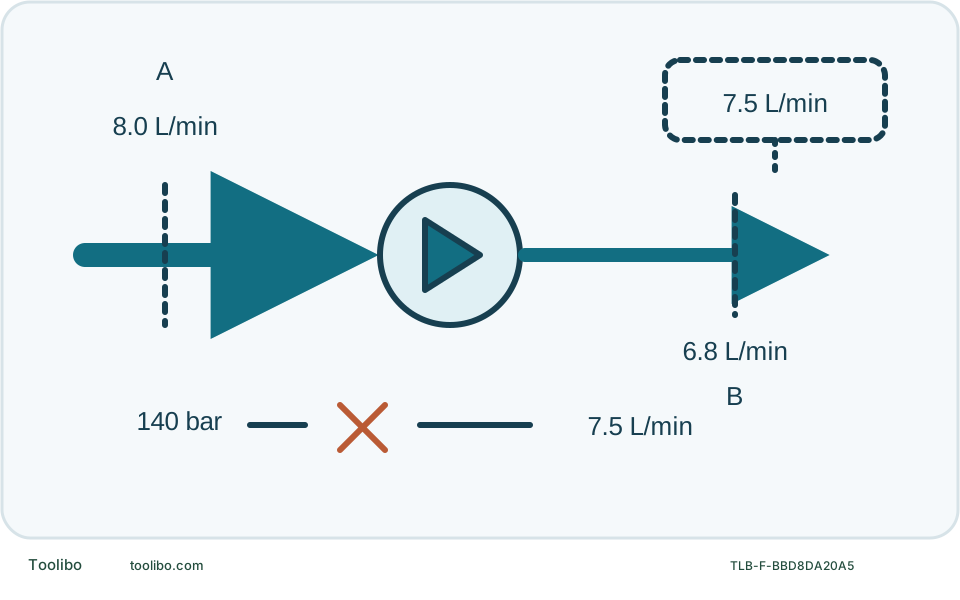
Supply
8.0 L/min minimum at the inlet.
Rated output
6.8 L/min is an output rating, not the supply requirement.
Maximum
7.5 L/min maximum must not be paired with maximum pressure.
The inlet needs its own check; the maximum-output label is not a second simultaneous operating point.
Match the UK order before planning the job
This guide covers AdvancedAquatak 140, UK order 06008A7D70, not every green Bosch washer with a 140-bar label. The matching instructions identify the machine family as 3 600 HA7 D..; the family code helps match a manual but is not the retail order number. The UK package lists an 8 m polyurethane high-pressure hose, metal-barrel gun, lance, variable fan nozzle, rotary nozzle, 550 ml detergent nozzle and water filter. Check the delivered contents rather than assuming a patio cleaner is included.
The induction motor and three-cylinder metal pump are useful identity details, not evidence that the machine can run continuously without regard to its instructions. A small yard with a sound paved surface, a suitable power supply and an unrestricted tap is a plausible job. A distant plot supplied through an uncertain hose, a damaged painted surface or a circuit that trips is not a reason to turn the pressure up.
Three flow numbers answer three different questions
Swipe or scroll horizontally to see all columns.
| Value | Meaning for this model | What it does not prove |
|---|---|---|
| 7.5 L/min | Product-page maximum flow | Flow delivered at maximum pressure |
| 6.8 L/min | Manual rated flow | The minimum inlet supply |
| 8.0 L/min | Manual minimum supply flow | Permission to use dirty or hot water |
| 140 bar | Maximum allowable pressure | A safe setting for every surface |
| 110 bar | Manual rated pressure | Pressure measured at your particular nozzle |
Do not multiply separate maximum pressure and maximum flow figures to invent a cleaning-power comparison. The 2100 W input rating is also not a measure of water delivered to the paving. Before buying accessories or blaming the pump, establish whether the available supply can meet the inlet requirement.
A practical screening check is to measure clean water delivered from the end of the intended supply arrangement, with the washer disconnected and switched off. Use a known-volume container, record the time and calculate litres divided by minutes. For example, 8 litres collected in 60 seconds equals 8.0 L/min: that merely reaches the specified minimum and leaves no allowance for a fluctuating tap. This is an editorial check, not a Bosch calibration procedure or proof of adequate pressure under load. If flow varies or remains marginal, improve the approved supply arrangement before operating; do not compensate by running the pump dry.
Set up around the water and cable routes
- Identify a sound test area and a safe runoff route. Remove loose debris; keep people, pets and electrical equipment outside the spray area. Wear the protection required by the instructions and hold the gun with both hands.
- Inspect the high-pressure hose, gun, safety devices and electrical lead. Damage means stop, not tape over the fault. Keep the machine upright and stable; the hose reel is storage, not a winch for dragging the washer.
- Use clean water and a reinforced supply hose at least 12.7 mm (1/2 inch) in diameter. Meet the local water supplier’s backflow requirements. The manual specifies a Type BA separator for the drinking-water network; downstream water is not drinking water.
- Confirm the actual nameplate and electrical installation. The manual’s circuit-protection requirements need an installation-specific check by a qualified electrician if uncertain. Do not change a fuse, breaker or plug to make the washer run. Keep connections dry and off the ground; do not improvise a long extension.
- With the machine switched off, connect the approved water arrangement and open the tap. Unlock and squeeze the trigger until a steady flow removes trapped air. Release and lock the trigger, then switch on and unlock with the gun pointing safely down before starting the test.
Choose the nozzle for the material, not the stain
Start with the variable fan on a small inconspicuous area, using a conservative distance and a moving pass. Check after the first pass for colour loss, exposed aggregate, lifted coating or displaced joint material. If the surface changes, stop and change the cleaning method. Closer spraying is not the automatic next step.
The rotary nozzle is not a universal shortcut: the manual excludes its use on motor vehicles. The detergent nozzle is a separate 550 ml attachment, not the variable fan with a different pressure number. Use only a suitable pressure-washer detergent in accordance with its instructions; do not mix products or assume all cleaners are compatible with the pump and surface.
Distinguish normal stopping from a fault
The motor stopping when the trigger is released is the automatic stop function. It does not isolate electricity or release stored pressure. If the jet pulses during spraying, stop and investigate supply restrictions, trapped air and the accessible filters before repeatedly restarting. This model has both internal and external water filters in the manual’s owner-maintenance illustration; that does not authorize opening the motor or pump housing.
At the end, switch off, unplug with dry hands, shut off the water and release remaining pressure with the gun directed safely before disconnecting hoses. Clean only the owner-accessible items described in the manual and store frost-free. Persistent leaks, damaged couplings, an electrical trip, unusual humming or a fault that returns after the allowed external checks belongs with service, not a pressure adjustment.
Models referenced