
Simple distances, corner access and ten-result history
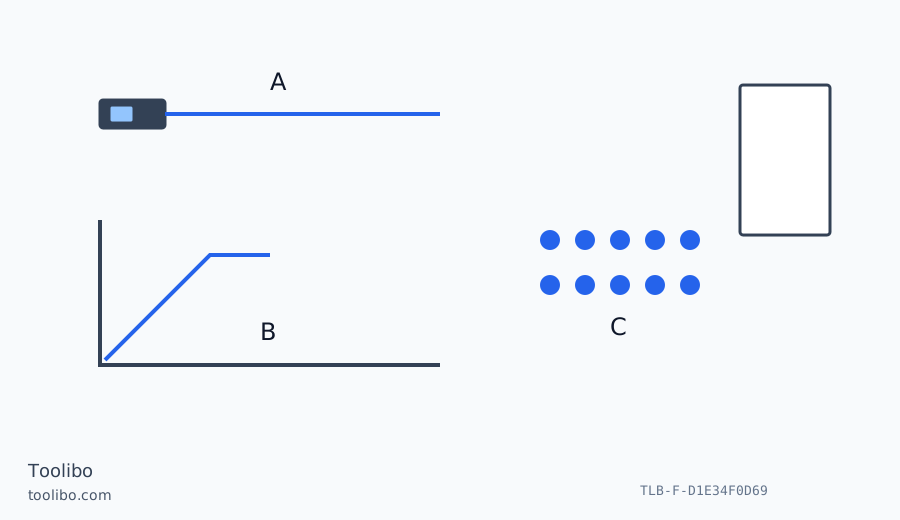
A direct span is shown above a corner endpiece, with ten small history marks beside a separate phone record.
A
A simple distance still needs a named position.
B
The endpiece helps only when the tip reaches the intended contact.
C
Ten-result history remains a temporary labelled-workflow aid.
The documented D2 v1 has Bluetooth and ten-result memory; generation identity remains essential.
Compare the exact D1 and discontinued D2 v1
This comparison concerns the documented Leica DISTO D1 and the discontinued DISTO D2 v1 identified in Leica’s US product and support records. A newer D2 or D2G is outside its scope. The D2 v1 manual prints DISTO D2, while the official support directory supplies the generation link. Confirm that identity before applying these operating distinctions to a used instrument or an online listing.
The D1 manual describes single-distance measurement, permanent measurement and Bluetooth Smart transfer. The D2 v1 documentation also includes Bluetooth Smart, so this is not a comparison between a connected D1 and an assumed non-wireless old D2. Avoid choosing from the product name alone. The more useful differences concern how you reach the starting point and how the instrument supports a sequence of measurements.
Match the contact arrangement to the actual room
For accessible wall-to-wall dimensions, plan a stable contact with a clearly identified target. The D1’s simple distance workflow can be sufficient when you can place the meter correctly and record the purpose of each reading. Permanent measurement is useful for watching a changing distance, but the value you finally accept still needs a defined position. Do not treat an unlabelled stream of changing numbers as a room survey.
The D2 v1 adds a documented multifunctional endpiece with automatic reference adjustment in the described positions. That can help reach an internal corner which the housing would otherwise struggle to contact. Inspect the actual tip contact as well as the displayed reference. Rounded plaster, trim or a projecting hinge can prevent the intended point from being reached even when the automatic system responds normally.
If buying used, a clear model identity and an intact endpiece matter more than a claim that every corner is easy to measure. Do not force a damaged or sticking part into place. Where the physical start cannot be reproduced, choose another suitable method or a labelled alternative baseline. No endpiece turns a curved finish into an exact imaginary sharp corner.
Verify the recording path before surveying a room
Both documented devices have a Bluetooth-related workflow, but current software compatibility must be checked separately. Historical manual language does not guarantee that a particular present-day phone or application is supported. Transfer one clearly labelled test distance and confirm the value, unit and destination field before relying on a large series. Keep manual recording available if that connection is not established.
A transferred value still needs a location and purpose. Name the room and span before measuring, and verify that the destination field represents the same dimension. A correct number placed against the wrong wall can be more misleading than an obviously missing entry. Connectivity reduces transcription work only when the receiving record preserves the meaning of the measurement.
Compare a single reading with a short working sequence
The D2 v1 manual documents ten-result memory. This is a practical distinction from the D1’s simple distance-led recording workflow, not a reason to treat the D2 as an unlimited project archive. Suppose you collect the width and depth of an alcove, then a second width at a different height. Give those three dimensions separate names before taking them. A later recalled number is useful only if you can still identify which setup produced it.
On the D1, write down or transfer each accepted distance while the meter is still at the named position. On the D2 v1, the temporary history can help check a recent result, but transfer the accepted values to the same kind of labelled plan. Do not postpone identification until the history contains several similar numbers. If a recalled entry cannot be tied confidently to its original span, remeasure that span rather than guessing from numerical order.
Before purchase, decide which task actually causes difficulty: reaching a corner, preserving a few recent readings or moving a value into verified compatible software. Those are separate requirements. Compare the complete workflow and the condition of the offered instrument instead of ranking models by the quantity of features alone.
Keep lasers away from eyes, people and optical instruments. Room planning measurements are not evidence of structural safety, hidden-service locations or an installation’s required clearances. For a consequential fit or fabrication decision, independently verify the exact dimensions and follow the relevant installation requirements.
Models referenced