
Makita dial and LCD: temperature ranges and airflow
A dial with two ranges, a display with two heating flows, and a separate cooling position.
A
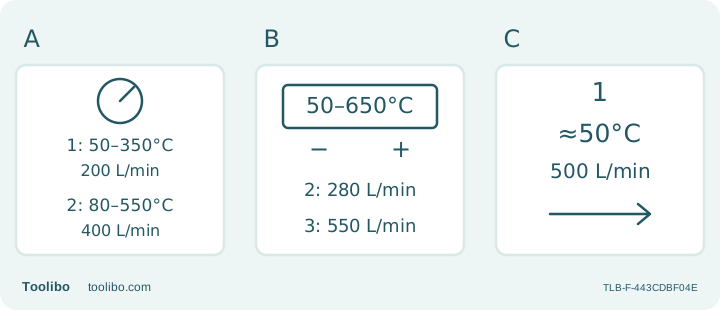
A shows HG6031V’s dial with two different ranges: position 1 gives 50–350°C at 200 L/min; position 2 gives 80–550°C at 400 L/min.
B
B shows HG6530V temperature selection at 50–650°C in both heating positions: 2 gives 280 L/min and 3 gives 550 L/min. The display is not a workpiece thermometer.
C
C separates HG6530V position 1 cooling: approximately 50°C at 500 L/min. It is not room-temperature air and does not establish that the nozzle can be touched.
HG6031V links each airflow position to a different dial range; HG6530V has two heating flows and a separate cooling position. Tool ratings are not workpiece temperatures or material recipes.
Establish the machine identity before comparing controls
HG6031VK is the US package linked to the HG6031V instructions. HG6530VK corresponds to HG6530V. Both manuals cover other tools as well. Combining every section would invent a machine that Makita does not sell. The HG6030 cooling position is not an HG6031V control, and the HG6531C application programmes are not HG6530V features. Match the machine nameplate and panel to the relevant manual column before treating a demonstration as applicable.
Once those boundaries are clear, the practical comparison is a temperature dial with two airflow settings versus buttons, an LCD and a separate cooling position. Compare what those controls allow within the material supplier’s permitted process. Different maximum settings do not establish a universal quality ranking. A setting outside the material’s permitted process is not an advantage merely because it is available.
The US control maps differ beyond the display. HG6031V uses 200 L/min with 50–350°C in I, or 400 L/min with 80–550°C in II. HG6530V offers 50–650°C in both heating positions: 280 L/min in 2 and 550 L/min in 3, plus approximately 50°C/500 L/min cooling in 1. Thus the dial model changes its available temperature range with airflow; the LCD model keeps the same heating range across two flows. These are tool ratings, not material temperatures or processing recipes.
Decide whether the display answers your actual question
The HG6530V instructions describe air-temperature indication. This helps distinguish a selected target from the changing air condition, but does not show the temperature inside your sample. Likewise, the numbered HG6031V dial is not a calibrated material-temperature setting. Both arrangements require an appropriate sample and inspection after cooling. Neither replaces the material supplier’s processing instructions.
If a supplier requires a process that neither tool can reliably provide, a display does not solve the mismatch. Choose an appropriate process rather than inferring the condition of a surface solely from the tool. A photograph of the panel can record your control choice; it cannot demonstrate that every layer of the object reached an acceptable condition.
Compare the actual package inventory
The US HG6031VK listing includes a case and describes nozzles separately. The HG6530VK listing includes a case and four nozzles. This may change the equipment you need initially, but only accessories appropriate to a permitted job are useful. An included glass-protection nozzle does not authorize heating household glazing in this guide.
A narrow outlet, broad outlet and reflector change the area receiving hot air. Reevaluate the sample after changing them. Fit attachments only with the tool unplugged and completely cold, checking approval and retention rather than assuming that a similar diameter proves compatibility. Package contents and machine controls are separate purchasing questions; answering one does not answer the other.
Plan how even a short job ends
HG6530V has a dedicated cooling position, while HG6031V instructions call for reducing temperature before switching off. Both require stable support, a cable that will not pull the tool over and sufficient cooling before moving or storing. Their instructions include at least thirty minutes of cooling before storage. A case is not a cooling stand merely because the gun fits inside it.
Choose the configuration compatible with the documented task and the shutdown routine you will actually follow. This comparison does not report practical measurements of heating speed, noise or durability. It does not rank value or transfer US electrical and package information to similar-looking tools sold in other markets.
Keep neighbouring-model features out of the decision
A careful comparison can include a column headed “not on this model.” For HG6031V, exclude the HG6030 third position. For HG6530V, exclude HG6531C application programmes and language controls. This is particularly useful when a demonstration or accessory description covers more models than the tool in front of you.
Check the nameplate and control layout together. If a used listing gives a kit number but shows a different panel, ask for clarification instead of interpreting the difference as an extra feature. The correct document is part of a usable purchase, not an optional addition to find after the first project.
Count useful accessories rather than loose pieces
Compare where attachments will cool as well as where they will be stored. A larger kit may require more organization if you alternate between nozzles. Do not count each included piece as an advantage without a permitted task and a safe handling routine. A small verified set is more useful than many attachments with unclear compatibility.
Make your final choice by connecting the permitted process, available controls, verified package and shutdown arrangement. If one link is unresolved, resolve that question before buying or heating. This keeps a convenient LCD or a full case from concealing a basic mismatch between the tool and the intended work.
Models referenced