
Three differences that change the work route
Paired hose sizes, separate filter families and pour-versus-drain arrangements.
WD4070
- 4-gallon portable drum; 1-7/8-inch accessories; VF3500 dry filter and VF3501 dry bag family; wet-application filter for larger liquid jobs.
- WD40700; SP6732-9 03/21; WD40700 US 120V only. Shared document also covers WD4070EX0 and WD4071M0. Printed 2 safety, 6–7 wet/dry/float/emptying, 9 filter, 10 identity.
HD1200
- 12-gallon drum with drain; 2-1/2-inch accessories; VF4000 dry filter; SP7160 specifies VF7000 for larger liquid jobs.
- HD12000; SP7160 04/24; printed 1 identity; 2 safety; 6 wet/dry and VF7000; 7 drain/blower; 9 filter. Does not authorize hazardous-dust collection.
Connection family
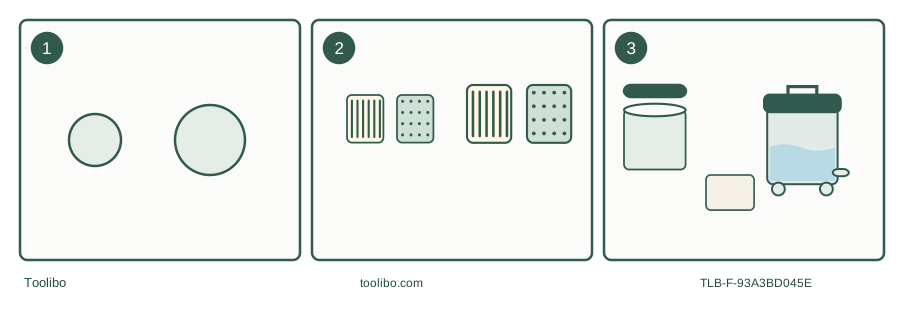
WD4070 uses 1-7/8-inch accessories; HD1200 uses 2-1/2-inch locking accessories.
Filter family
Small and large RIDGID wet/dry consumables have different identifiers.
Emptying route
Plan controlled drum emptying for WD4070 or suitable drain access for HD1200.
Schematic comparison, not to scale; no suction advantage implied by the circles.
Compare the job route, not the matching horsepower labels
The US RIDGID WD4070 and HD1200 both carry a 5.0 peak-HP designation. That does not establish equal real-world suction, and it does not tell you which is easier to empty after your job. Peak horsepower is a laboratory motor measure. This comparison instead uses documented drum size, hose family, filtration and emptying arrangements to help you plan ownership.
Confirm the full identities first: WD4070 corresponds to WD40700 in SP6732-9, while HD1200 corresponds to HD12000 in SP7160. The WD document also covers other regional models; follow the US nameplate. Neither guide should be applied to a different NXT size simply because the colour and filter fastening look familiar.
Two different routes through a room
The WD4070 has a nominal 4-gallon drum, 1-7/8-inch accessory system and a listed 20-foot cord. The HD1200 has a nominal 12-gallon drum, 2-1/2-inch locking accessories and a listed 15-foot cord. Both listings describe a 7-foot hose. A larger tank therefore does not necessarily give you more electrical reach.
Imagine cleaning a car beside a crowded garage shelf. The important questions are where the drum can sit, whether the door can close without trapping the hose, and how you will carry out the waste. The smaller WD4070 layout may fit that route more naturally, but measure your actual storage space rather than relying on a “portable” label.
For a larger floor-cleanup area, consider the HD1200’s larger hose family and floor-tool arrangement. The current listing describes an NXT Max floor tool with wet shoe, but older or store-specific kits can differ. Verify the box contents before planning a job around a particular nozzle. No cleaning-speed advantage is inferred here from diameter alone.
Separate the two filter families
WD4070’s listed dry cartridge is VF3500, with VF3501 dry bags and VF3700 as the smaller wet-application option. HD1200’s listed general-debris cartridge is VF4000, with VF3502 dry bags and VF7000 for the larger wet-application setup. Those identifiers are more useful when restocking than a vague request for a “RIDGID shop-vac filter.”
Do not assume a bag and cartridge are interchangeable just because both sit inside the drum. The bag receives debris at the inlet; the cartridge protects the airflow path at the motor-side cage. Their fit and media purpose both matter. Keep dry consumables separate from wet parts in storage, particularly if both machines share a workshop.
Current listings contain several filtration choices, including HEPA and HEPA-material wording. A listed filter option alone does not establish that either complete machine is suitable for lead, asbestos or other hazardous-dust work. First determine whether the substance is within the vacuum’s permitted use, then choose the correct consumable.
Their matched wet instructions share a boundary
Both matched RIDGID manuals permit the existing filter to remain for a small quantity of liquid, described as less than 2 inches (5 cm) collected in the drum. For larger liquid pickup they call for the appropriate wet-application foam filter instead of dry-only paper media. HD1200’s SP7160 names VF7000 explicitly. The cage and float remain installed on both machines.
This similarity should not become a universal wet-vac rule. Other brands and other document revisions can require a cartridge to remain installed. Read the instructions for the machine being used, particularly when borrowing a vacuum or inheriting one without its original filter.
On either RIDGID, a full-liquid float interrupts airflow while the motor can continue running. A higher-pitched sound with loss of suction means switch off, unplug and empty. More nominal gallons does not mean permission to ignore that signal or collect a measured twelve gallons of water.
Emptying is the practical dividing line
The WD4070 procedure removes the powerhead for emptying the drum. HD1200 provides a built-in drain for liquids. Think about the receiving point: a low drain opening can be useful beside a suitable container, but less useful if you must carry the machine over stairs first. Conversely, a small drum still needs to be lifted and poured carefully.
Choose by the whole cycle: getting the machine to the work, fitting the right nozzle and filter, collecting a manageable amount, emptying without a spill, and drying it before storage. If most jobs are short dry pickups in tight spaces, prioritize that route. If suitable liquid jobs are more frequent, consider access to the HD1200 drain and wet-filter supplies. These are conditional planning considerations, not an independently tested winner.
Neither machine should collect flammable liquids, hot material, explosive dust or toxic substances. The disposal destination depends on the collected contents, not the brand of the bucket. Prices, availability, warranty eligibility and current store bundles are outside this comparison.
Models referenced