
A documented choice, not a feature score
Two exact model labels, separate beam and notch symbols, distinct control-recognition marks and a final decision sheet.
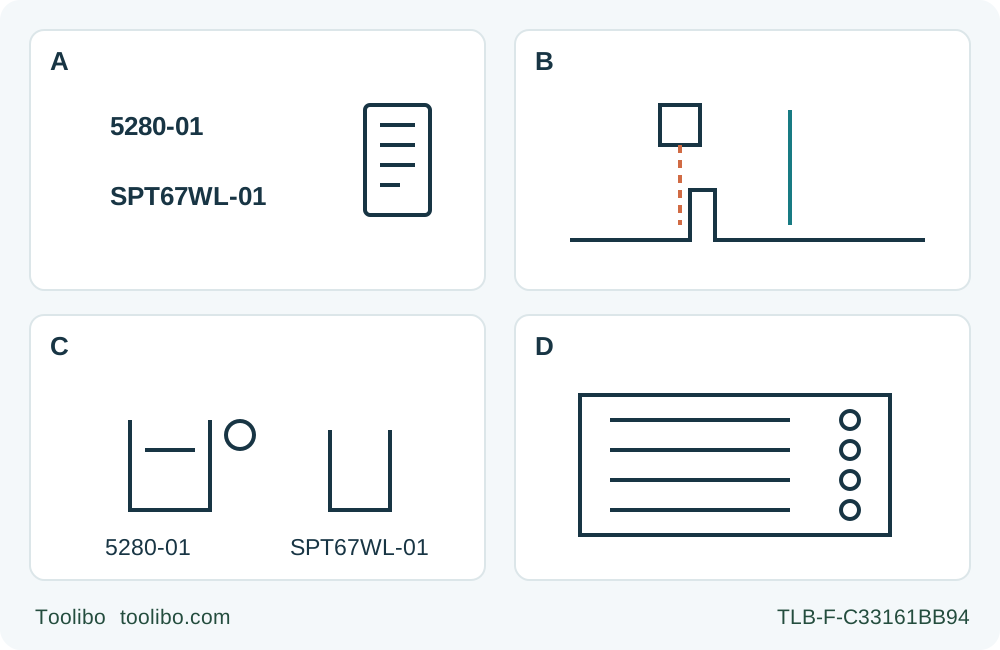
A · Match the actual model
Record 5280-01 or SPT67WL-01 and its complete matching manual; do not infer drive architecture from appearance.
B · Separate reference methods
For 5280, distinguish factory supplied-blade laser reference from approximate notch and measured kerf. Both manuals require actual sample verification later.
C · Rewrite the controls
Record the 5280 safety release and wing nut separately from the SPT67WL trigger and bevel lever. Recognition is unplugged; no adjustment recipe is shown.
D · Close the decision sheet
For identity, reference, controls and condition, mark established or held. Consider a candidate only for the documented task, without averaging away a defect.
The four panels are conceptual comparison prompts, not physical control locations or a running-cut setup. The 5280 laser requires connected power; this comparison requests no live demonstration. Both candidates remain unplugged for handling. The final sheet records established facts and unresolved holds, not a safety rating.
A laser line and a Sidewinder name answer different questions. The first describes a visual reference; the second is the manufacturer’s name for the SPT67WL-01 product. Neither tells you whether the particular saw has a sound guard, a correctly fitted blade or controls you can use without importing habits from another model. This comparison produces a documented shortlist and a control-transfer sheet, not a cutting-speed contest.
The scope is the US SKIL 5280-01 under its 03/22 instructions and the SPT67WL-01 under manual 1619X08870. Both must retain their correctly installed original wood-cutting assembly and match their actual nameplates. This is not a blade-fitting, clutch-setting, laser-adjustment or bevel-cut tutorial. A used example with uncertain assembly stays on hold regardless of how attractive its feature list looks.
Write the task before comparing features
Describe the intended work as a material, thickness, cut type and workspace, rather than “general DIY.” For example, known loose wood requiring supported square cuts is a useful bounded task. Unknown reclaimed stock, hidden fasteners, an unsupported long reach or an improvised table-saw conversion are not made acceptable by either model. Record how you will clamp retained work, support both portions outside the blade path and let waste separate without closing the kerf.
Next list the features that would actually change your preparation: a projected reference you intend to use, the starting-control sequence, the way bevel is locked, and the service information available for the actual saw. These are selection questions. Do not connect either tool simply to compare its sound, trigger response or apparent power. An isolated documentary comparison can end with neither candidate accepted.
Keep the complete matching instructions with the sheet. A model number on a sales card does not prove that a borrowed saw still has its original washers, blade or controls. Record the physical nameplate, manual identity and any unresolved mismatch separately. The current SPT67WL product is explicitly named Sidewinder; its “Worm Drive inspired” description is not evidence that it is a worm-drive saw. This comparison does not assign an undocumented drive architecture to the 5280.
Decide whether the laser solves your reference problem
The 5280 manual says its laser is factory set to the kerf of the supplied blade. It also says the foot guide can have a different setting. Thus laser, notch and resulting cut are three references to compare, not three guaranteed coincident lines. A replacement blade or uncertain original assembly breaks the assumption that the factory relationship remains applicable. Do not try to correct disagreement by adjusting the laser in this comparison.
Without the laser, the 5280 uses the right edge of its notch for a straight 90-degree cut and the left edge for a 45-degree cut. The SPT67WL manual likewise uses the right edge for zero bevel and the left for 45 degrees. Both describe an approximate cutting reference that needs a scrap sample to establish the actual line. A familiar notch direction therefore transfers as a recognition aid, not as a numerical guide offset or an accuracy guarantee.
The 5280 laser adds an operating constraint: it needs the tool connected to power and its laser button pressed. Looking at a projected line is not an unplugged setup check. Its Class IIIA beam requires avoiding direct eye exposure, people and reflective work; optical instruments and tinted glasses are not visibility remedies. A buyer who cannot use the reference under those conditions should not count it as a solved alignment need. This sheet requires no energized laser demonstration.
For a later qualified square-cut workflow, support, a securely fixed guide and measured sample acceptance still matter. A beam does not hold the foot against a straightedge, resist a moving clamp or stop an offcut pinching the blade. Choose a documented mechanical guiding method first. Treat the laser as an additional reference whose limitations you accept, not a substitute for that method.
Rewrite the starting and locking sequence
The 5280 has a safety release pressed by the thumb from either side of the handle before the trigger is pulled. Releasing the trigger automatically re-engages that safety control. Its power indicator illuminates when the tool is supplied with power. Neither the release nor a lamp state provides physical isolation: unplug before handling settings, inspecting the blade or moving a guide.
The SPT67WL instructions describe squeezing the trigger to start and releasing it to stop. Do not invent the 5280’s release-button sequence on this model, and do not use the absence of that documented step as permission to handle a connected saw casually. On the transfer sheet, write the complete actual sequence for each model instead of “same switch.” Keep both tools unplugged during identification. A switch that cannot reliably control the tool excludes it from use until repaired.
The bevel controls also differ. The 5280 uses a front wing nut. The SPT67WL uses a front lever and documents a separate 45-degree spring stop for going beyond that point. These are recognition distinctions, not instructions to bypass a stop. The 5280’s product/table capacity and its procedure do not give a clean shared high-angle instruction: the procedure says up to 45 degrees while marketing specifies 51. This comparison holds high-angle operation rather than borrowing the SPT67WL sequence to fill that gap.
Even the isolated square-check correction is model-specific: the 5280 manual describes a tab, while the SPT67WL describes an alignment screw. This sheet authorizes neither correction. A failed square check is a reason to resolve the exact procedure or obtain qualified help, not to bend a part because another saw’s manual mentions bending. Set any later ordinary work up under its own complete owner instructions.
Do not turn shared clutch wording into a safety ranking
Both manuals describe Vari-Torque action through friction between the outer washer and blade. They warn that excessive bolt tightening defeats its effectiveness. That is enough to establish an ownership requirement: the original matched assembly and its qualified setting matter. It is not permission to deliberately stall a blade, test clutch slip or apply a generic tightening rule.
The clutch is not an electronic kickback detector, a motor brake or a guarantee against kickback. The current SPT67WL table explicitly lists no electric motor brake. For either candidate, do not assign a universal stopping time from the label or compare safety by counting features. After a normal cut, the documented workflow includes releasing the trigger, maintaining control through complete standstill and ensuring the guard covers the blade before setdown. A later binding event requires its own stop-and-assess response; this comparison teaches no restart.
Inspect documentary completeness around the guard, depth lock and original blade before considering convenience features. A sticky guard, damaged cord, unexplained blade slip or uncertain washers is not a small disadvantage to average against a laser or preferred handle. Mark it as unresolved and stop that candidate’s operating plan.
Include ownership work in the decision
Neither manual describes a maintenance-free saw. Both discuss keeping openings and switches clear, inspecting service items and using appropriate service support. The SPT67WL lubrication section says the tool is already lubricated and recommends special gear lubricant at brush changes. That is not the pre-use oil-level routine of a separate worm-drive model, and it is not a homeowner gear-service recipe.
For selection, ask whether the actual tool has known service history and whether you can obtain the correct instructions and competent service. Do not open brush caps, use solvents or dismantle a clutch just to complete a shopping comparison. Unknown maintenance is a cost and scheduling uncertainty to resolve, not evidence of a specific internal defect. A seller’s smooth powered demonstration cannot establish all of these conditions.
Finish with four written lines for each candidate: identity and original assembly; guiding reference and its limits; exact switch/lock controls; unresolved condition or service needs. Mark each line established or held. Then choose “consider for the documented task,” “hold for evidence or correction,” or “reject for this task.” This is not a safety certification or a hands-on performance verdict.
A defensible outcome might favor the 5280 because its documented laser reference genuinely fits the owner’s conditions, or the SPT67WL because its documented controls suit that owner’s established workflow. It can also leave both held. The useful result is a reasoned choice with a specific owner workflow to learn next—not a claim that a laser, a brand family or the word Sidewinder makes one saw universally better.
Models referenced