
Choose a complete household workflow
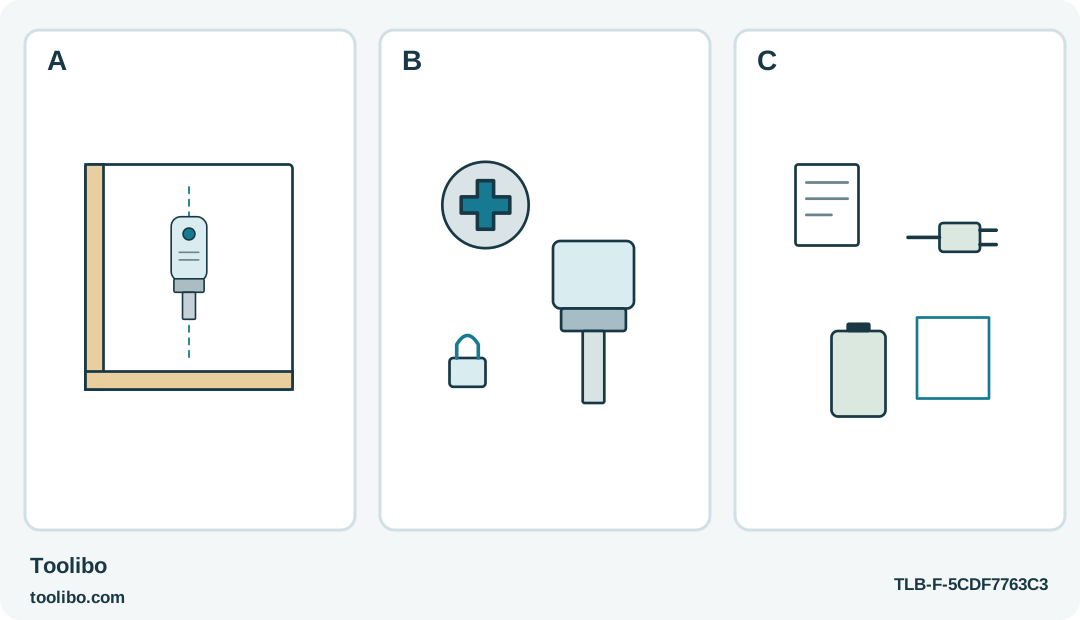
A cabinet access rehearsal, separate tip and retention checks, and identified charging and battery-service items frame the first-tool decision.
A
Start with real permitted jobs and enough space for a straight approach, gripping hand and withdrawal.
B
Understand the exact start-stop routine and compatible bit-retention system; an accessory count does not decide fit.
C
Keep approved charging equipment identifiable and understand the manufacturer’s battery-service route before choosing.
The first-tool choice starts with actual jobs, then checks access, controls, bit retention and a charging routine that can be managed together.
List three real jobs before comparing tools
A first electric screwdriver should make a recurring household task easier, not create a reason to use power on every screw. Write down a few ordinary jobs you genuinely expect: assembling a permitted small furniture fitting, removing accessible non-electrical hardware or working repeatedly on a matching set of screws. Note the access space and the maker’s fastening instructions.
Exclude tasks that require calibrated tightening, structural fastening, electrical work or the removal of seized screws from this starter list. A compact driver is not a substitute for all hand tools, and its small size does not make every repair a beginner task. If most of your jobs require only a final fraction of a turn, a good manual screwdriver may remain the more useful choice.
Match body shape to the screw axis
Look at the space for both tool and hand. The WORX WX240L has a compact straight arrangement, the SKIL SD561802 offers a pivoting handle, and the Bosch IXO8 uses its own compact body layout. The English-export VESSEL 220USB-1E emphasizes a ball-grip style with a powered-to-manual handoff. None of those descriptions proves the tool will fit your cabinet.
Rehearse the intended approach with power disabled if you can inspect the tool. The bit must align with the screw and withdraw cleanly. A pivot changes handle position, not the direction in which the bit drives. Do not choose a model on the assumption that an improvised extension or an angled bit will solve missing clearance later.
Decide which control you can use deliberately
The WX240L’s three selections adjust torque rather than providing three speed settings. The SD561802 uses a trigger with a direction selector and a lockable pivot. The VESSEL uses a slide control that must be released before manual turning. The IXO8 has its own trigger and direction-lock arrangement. Try to understand the complete start-stop sequence, not just how the switch feels once.
Ask whether you can release the control promptly in the actual working position. A control pressed by a cabinet edge or awkward grip is not a convenience. Do not infer fastening accuracy from the number of settings alone; a sound joint still needs the correct bit, support and an observable seating endpoint.
Check the accessory system you will maintain
A supplied box of bits can be useful, but the number of pieces does not tell you whether the right profile and shank are included for your work. Check exact bit-retention requirements. In particular, the VESSEL export model’s mounting dimensions must not be generalized from another regional variant or from the phrase quarter-inch hex.
Plan how you will identify and replace a worn bit. A magnetic holder, a sleeve and an attachment system have different setup checks. If a particular optional attachment is essential to your task, confirm its exact compatibility rather than treating every accessory shown in a photograph as part of the tool or set you are buying.
Consider the battery after the first project
Identify the approved charging arrangement and whether its equipment will be easy to keep with the tool. A familiar USB connector is not a complete supply specification. Check the actual regional model’s instructions and do not transfer a charging time or connector from an older generation.
The Australian IXO8 generation has a manufacturer-specified replacement-battery design; that is a genuine distinction from sealed older designs. It does not authorize opening cells or fitting an improvised pack. For the other models, understand the manufacturer’s service route for a failed integrated battery. Battery access and repair support may matter more over time than an accessory you rarely use.
Make the final choice with a small trial plan
Choose the tool whose access, controls, bit system and charging arrangement suit your real jobs. Avoid claiming a winner from maximum torque figures measured under different conditions or from an untested impression of power. Exact regional product identity matters more than a shortened model name on a marketplace listing.
Plan the first permitted fastening on matching spare material, with the work supported and eye protection in place. Keep the correct hand tool available for starting or finishing where the furniture instructions require it. A good first driver fits into that controlled method without demanding exceptions. If you cannot explain how you will align, stop, inspect and store it, resolve those practical questions before adding more power or accessories to the decision.
Models referenced