
Pressure start and trigger start need different rehearsal
Axial pressure, a separate trigger action and a cabinet clearance rehearsal contrast the operating workflows.
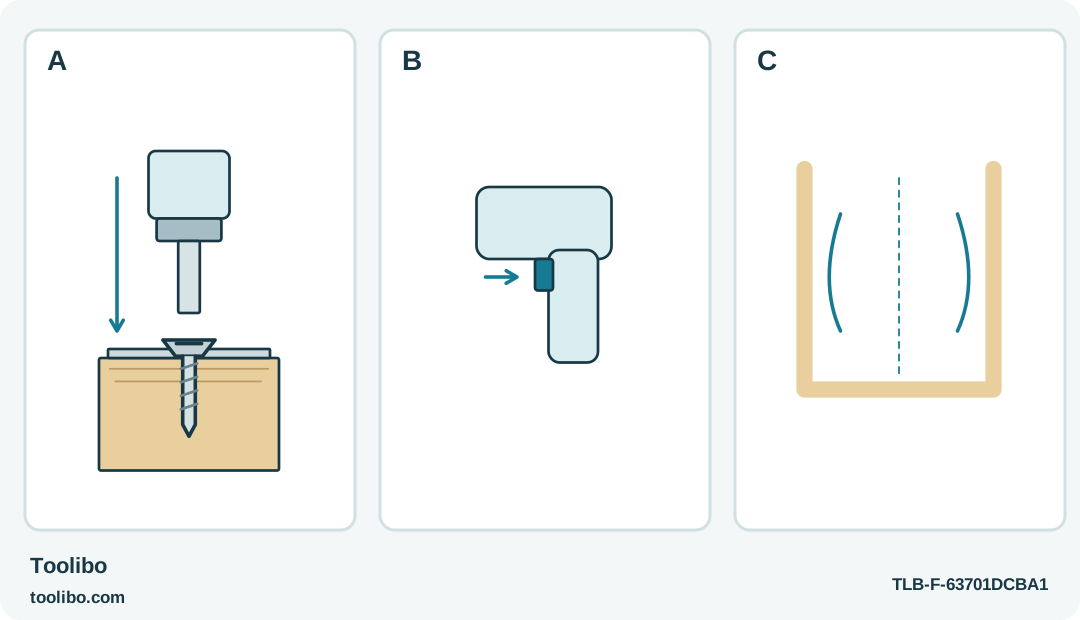
A
PushDrive starts under axial pressure and has six documented torque stages.
B
IXO7 starts with its trigger; its optional torque attachment is not a built-in clutch.
C
Rehearse the whole approach, control release and withdrawal; do not assume accessories transfer between the tools.
Pressure starting and trigger starting demand different hand movements; compare the entire approach and release, not just the tool outline.
Compare the start action first
The Great Britain Bosch PushDrive and the UAE-listed IXO 7 can both look attractive for light household fastening, but they ask your hand to do different things. PushDrive starts when pressure is applied along the screw axis. The IXO 7 starts when its trigger is pressed.
That difference is more useful than a vague description of one tool as easier. Think about a real supported screw: how will you seat the bit, hold the work, begin movement and stop near the final position? A control that feels convenient on an open bench may feel less natural inside a narrow compartment.
Keep the comparison within ordinary non-electrical tasks. Neither activation style changes the need for a suitable screw, compatible bit and stable workpiece. If the approach is so awkward that you cannot see or control the fastener, improve the setup before choosing between the tools.
Where pressure activation can help
PushDrive combines the forward driving pressure with the motor start. On a clearly visible screw in a well-supported part, that can make the sequence feel direct: align, apply controlled pressure, drive, then remove pressure to stop.
The same feature requires care during positioning. Pressing against a screw while adjusting your grip can become a start command if the tool is not locked. Use the middle lock position during bit changes and setup, and do not test activation against your hand.
PushDrive also provides six torque stages. Establish a suitable setting through a conservative trial with the actual screw and material rather than treating the number as a universal tightening specification. Do not transfer the optional IXO adapter’s scale or another driver’s clutch number to this ring.
Where a separate trigger can help
The IXO 7 gives you a separate trigger action after the bit is positioned. That separation can suit a user who wants to establish the approach and then make an independent start decision. It still requires keeping the trigger finger clear until ready; a trigger is not a guarantee against an accidental start.
The bare IXO 7 should not be described as having the optional torque adapter’s ten-stage adjustment built in. If that tightening control is important, check the exact compatible adapter and the complete resulting tool geometry.
The IXO attachment system also distinguishes offset access from a changed driving direction. Those options may matter for a particular furniture corner, but they are separate from the trigger-versus-pressure decision. Do not assume that an attachment listed for IXO fits PushDrive or that either tool automatically includes every accessory shown in a range photograph.
Rehearse the full fastening sequence
Before buying or choosing a tool you already own, make an unpowered rehearsal around a representative fitting. Check the room for your hand, the body and the bit when the screw is at its final position. Keep the work supported rather than holding a loose part against your body.
For PushDrive, ask whether you can apply and remove axial pressure cleanly without shifting the work. For IXO, ask whether your grip leaves the trigger easy to release without tilting the bit. A short tool is not useful if its control ends up trapped against a sidewall.
Then make a suitable sample fastening. Start the screw squarely, keep the tip fully engaged and stop if the screw binds, the bit slips or the work moves. Judge the joint rather than the sensation that the tool is still willing to turn. Neither control style is a remedy for a damaged hole or an incorrect fastener.
Choose for your routine, not every possible job
PushDrive is a reasonable candidate when you value pressure activation and its built-in torque stages for supported, accessible work. IXO 7 is a reasonable candidate when a separate trigger and its specific compatible attachment choices better suit the way you approach your screws.
Keep charging equipment and bit requirements model-specific. PushDrive’s instructions exclude two-sided blades longer than 25 mm; do not assume that a bit assortment useful elsewhere is automatically suitable. Do not operate either tool from an uncertain charging arrangement or infer compatibility from connector appearance.
If a few difficult jobs dominate the decision, compare a suitable hand driver or another tool for those jobs rather than forcing either compact model to do everything. The practical winner is the tool that lets you position, start, stop and inspect with less awkwardness while preserving the limits of the actual assembly.
Models referenced