
Handle position is not an angled drive
A fixed pistol silhouette, a pivoted handle sharing a straight spindle axis, and a hand-clearance envelope compare access requirements.
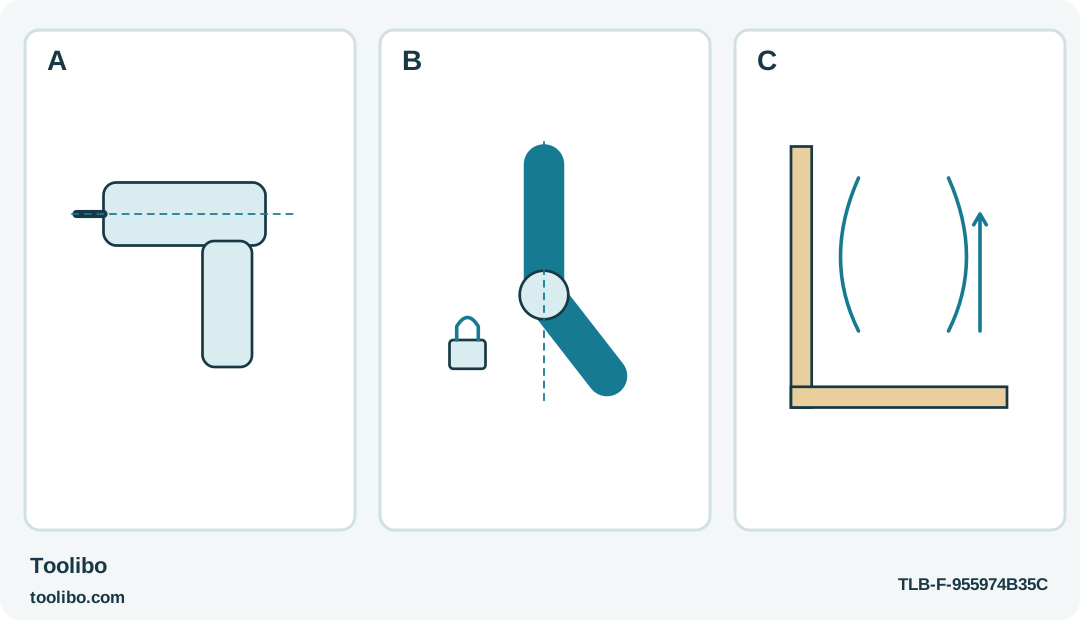
A
A fixed pistol grip has a particular body and hand-space envelope; check the actual BDCS20 and compatible bit.
B
A stopped, locked SD561802 pivot changes the handle position, not the spindle direction.
C
Rehearse control access and withdrawal in the intended space before choosing a grip.
The grip may move without turning the spindle’s working axis, and the available hand space must still allow a clean withdrawal.
Measure access with your hand included
A compact tool can fit inside a cabinet while leaving no comfortable space for the hand that must hold it. That is why a useful grip comparison begins with the job, not the tool’s silhouette. Look at the screw axis, the nearest side wall and the space your wrist needs while pressing and releasing the control.
The BLACK+DECKER BDCS20 provides a fixed pistol-style arrangement. The SKIL SD561802 offers a handle that can be changed between its permitted positions. This comparison concerns ordinary, visible furniture fasteners. It does not cover electrical fittings, hidden services or work that requires an unapproved accessory to reach around an obstruction.
What a fixed grip gives you
A fixed pistol grip has one basic arrangement to learn. The trigger, direction selector and handle relationship stay in the same place, which can make a repeated open-access job straightforward. You still need to check that the handle clears the panel through the whole fastening movement, not merely before the screw begins to advance.
On the BDCS20, use the central direction-slider position to lock the tool off during setup. Its spindle takes an appropriate single-ended bit, not a double-ended one. If the fixed body cannot align with the screw without touching the furniture, do not lean the bit or use the tool as a lever. Change access or select a suitable hand tool.
What a pivot can and cannot change
The SD561802 pivot changes the relationship between the grip and the driving axis. With the tool stopped and locked, operate its pivot-unlock knob, move the handle to a permitted position, release the knob and confirm that the handle has locked. Keep fingers clear of the joint, and do not over-twist the handle beyond its intended movement.
The bit still needs to remain on the screw’s axis. A straight grip may clear a side wall better, while a pistol arrangement may suit a different wrist position, but neither creates a right-angle drive at the tip. A screw that points away from the available opening remains an access problem, regardless of how the handle is folded.
Rehearse before making a powered trial
Use the actual intended bit and an unpowered approach to the supported work. View alignment from above and from the side. Check the space around the trigger finger, the back of the hand and the direction control. A grip is not suitable if the cabinet edge pushes a finger onto the switch or prevents a prompt release.
Withdraw along the same line after the rehearsal. A tool that can enter a recess but cannot leave cleanly after the screw head moves is not a good fit. Reposition a removable furniture part where its instructions permit, rather than making the final powered turn with your wrist trapped against an edge.
Test control, not just comfort
Secure a matching sample and wear eye protection for the powered trial. Keep hands away from the rotating bit and screw path. Start the correct fastener using the fitting maker’s method, engage the bit fully and make a short controlled drive. Release the trigger and inspect the joint before the head reaches its intended seat.
For both models, a comfortable grip does not excuse running a stalled motor or forcing a slipping bit. Stop immediately if rotation stalls, then determine the cause before considering another attempt. On the SKIL, confirm the pivot remains securely locked; unexpected movement of the handle is a reason to stop, not to squeeze it into place while continuing.
Choose for the jobs you actually repeat
A fixed pistol driver may suit open furniture assembly where the screw axis and hand space are predictable. A pivoting design may be worthwhile if you regularly encounter two genuinely different access arrangements and can change the handle safely before engaging the screw. One awkward recess alone is not a reason to assume the pivot will solve every access problem.
Keep a correctly fitting hand screwdriver available for places where neither powered configuration offers a straight, visible approach. Avoid improvised extensions, bent bits and pressure against finished edges. The better grip is the one that supports a complete controlled sequence: approach, start, stop, inspect and withdraw. If any part of that sequence depends on an awkward stretch or a hidden screw head, improve the setup before selecting a tool.
Models referenced