
Voltage identity before attachment choice
Two voltage-specific codes lead to a Premier kit with separate fan, turbo and detergent branches and two hose-end checks.
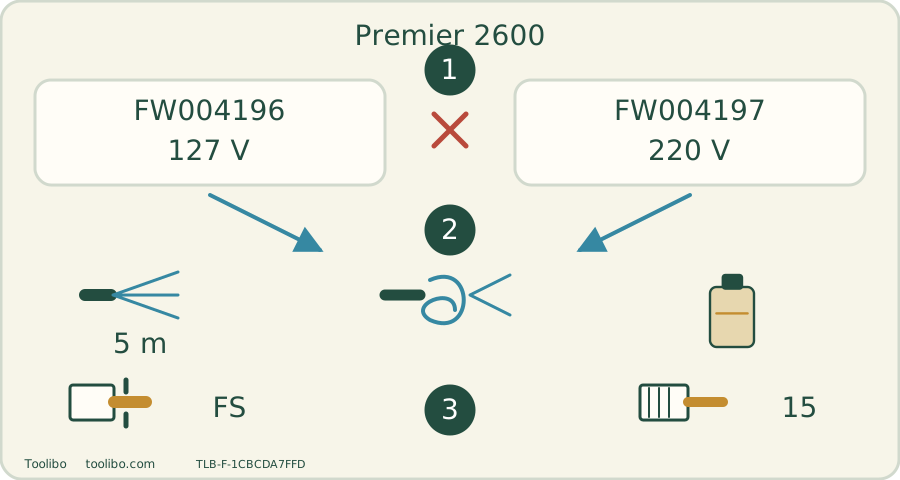
Identity
FW004196 127 V or FW004197 220 V; not dual-voltage.
Kit
5 m hose and separate adjustable, turbo and detergent attachments.
Fit
Match both hose ends and FS-family attachment, never brand name alone.
The diagram identifies the package; it does not replace the actual revision’s operating procedure.
Start with the voltage-specific code
This Brazil model is FW004196 for 127 V or FW004197 for 220 V. These are separate supply variants, not a dual-voltage machine. Match the actual rating plate to the local supply before connecting it. A plug that physically fits is not proof of voltage suitability, and an adapter does not convert voltage.
The manufacturer listing gives 1800 W, 60 Hz and 2000 PSI maximum pressure. The 2600 in the product name is not a 2600 PSI rating. The page also lists 360 L/h; the retrieved October 2016 manual calls 360 L/h maximum flow. Current rated pressure and rated flow are not established here, so do not turn these values into a guaranteed working pair.
A 20 A/10 A field appears in the product listing, but its role as running current versus connection requirement was not sufficiently established. This guide does not use it to size wiring or recommend a plug change. Resolve actual electrical suitability from the matching plate and instructions, with a qualified electrician where needed.
Inventory the kit before choosing a first task
The verified package includes a 5 m high-pressure hose, a 5 m electrical cable, a safety-lock spray gun, adjustable fan/concentrated lance, a separate turbo nozzle, detergent applicator and quick coupling. The listed net weight is 7.5 kg. Check the actual supplied pieces, especially on a used unit or a package with a different suffix.
The two 5 m lengths belong to different routes. They do not add to 10 m of cleaning reach. Lay out the high-pressure hose around the intended work while independently checking that the power connection stays dry and the supply hose remains unrestricted. Leave slack instead of allowing the hose to pull the machine.
A useful first planning task is a small, material-compatible washable area near the water source. Identify the correct fan attachment and where runoff will go. Do not begin with a delicate painted surface simply because the kit includes a turbo nozzle.
Keep the three attachment jobs separate
The adjustable lance changes the spray from a wider fan toward a concentrated jet. Begin with a suitable broad pattern and test an inconspicuous area. Changing the geometry changes the action on the surface; it is not a calibration dial for a known working PSI.
The separate turbo nozzle adds concentrated rotating action. Treat it as a different cleaning tool, not an automatic upgrade for every surface. Loose coatings, fragile joints and delicate materials may need a gentler method rather than another pass with the turbo.
The detergent applicator is another attachment route. Use only a compatible pressure-washer detergent at its label dilution and do not assume the same applicator is supplied with every WAP model. Prepare the rinse equipment before applying a product so you can rinse within its required dwell period.
Match FS-family parts by the whole connection
The official Premier accessory suggestions identify FS-family lance/gun parts and a 5 m hose described as quick-connect × M22 pin 15. This is useful identification evidence, but not permission to substitute any component whose listing says M22.
For a replacement, record four things before ordering: the exact machine voltage/model code, the connection at the machine, the connection at the gun, and the intended attachment’s mating interface. Photograph or inspect these only with the machine off, unplugged, water shut and pressure released. Compare the complete part description and manufacturer’s applicable-model list.
A threaded collar that starts to turn is not proof that the internal pin and seal match. Do not force a near-fit, add improvised adapters or assume an Ousada fine-bayonet part becomes compatible because both products carry WAP branding. If the match is unclear, leave the part unpressurized and obtain a confirmed replacement.
A pre-use identification checklist—not a complete startup procedure
This checklist establishes whether you have the right machine and documentation. It is not a complete executable startup sequence; use the instructions matched to the actual revision for connection order, water limits and purging.
- Confirm FW004196/127 V or FW004197/220 V on the actual plate, and check the matching supplied instructions.
- Inventory the hose, gun, lance, turbo and detergent pieces. Reject damaged pressure hose, broken locks or worn electrical parts before assembly.
- Choose a stable position with independent cable, inlet and pressure-hose routes. Connect only the identified compatible components while electricity is disconnected.
- Follow the actual revision’s water-fed assembly and air-purging sequence before powering the pump. A missing current procedure is not a reason to borrow timing or inlet limits from a different WAP model.
- Test the chosen spray on a small suitable patch. Stop if material lifts, roughens or leaks into vulnerable joints; do not compensate with a stronger jet.
The product describes Stop Total, but that does not mean trigger release is electrical isolation. Before changing attachments or finishing work, switch off, disconnect electricity, close water and release residual pressure safely. Never loosen a pressure fitting simply because the motor is quiet.
What this source match does not establish
The retrieved official operating manual is Rev.0 from October 2016. Its core specifications align with the product listing, but that does not verify every later unit’s extension-lead table, inlet-temperature limit, minimum supply flow, idle duration or draining orientation. This guide deliberately does not transfer those details from another model or claim the old revision is the latest.
For current-revision maintenance, match the manual to the actual machine. External inspection and keeping accessories clean do not authorize opening the pump or electrical housing. A damaged hose, failed trigger lock, recurrent electrical problem or unresolved leak is a stop-and-service condition. Keep stored equipment dry and protected from freezing, and obtain the exact procedure before using any pump-treatment chemical.
Models referenced