
Define the work and endpoint
Describe a result: preparing a new solid-wood shelf for a specified finish while retaining square edges. Record size, corners, curves, surface history and the next coating. Unknown coatings, uncertain veneer thickness, loose joints and structural damage are not invitations to try a more powerful sander.
Shortlist by contact shape
Swipe or scroll horizontally to see all columns.
| Main task | Starting option | Benefit and tradeoff |
|---|---|---|
| Broad ordinary solid-wood flats and scratch refinement | Random-orbit sander | Covers accessible flats; cannot reach square internal corners |
| Small internal corners and boundary areas | Pointed detail sander | Better access; less suitable as the main broad-area tool |
| Narrow mouldings, small curves and precise edges | Hand block or suitable hand method | Local control; slower over large areas |
| Significant removal or flattening | Assess belt sanding or another woodworking process | Needs allowance and control, not simply more pressure |
One panel may justify machine work on the main area and hand finishing at two corners, rather than two purchases. Do not tip a round pad onto its edge to force it into a corner.
Choose specific candidates
DEWALT DWE6423 and DCW210, and SKIL SR211601, are five-inch random-orbit examples. SKIL SR250801 is a pointed detail machine, not a quarter-sheet clamp sander. Select the class before comparing brand and power.
At a fixed bench, a corded DWE6423-type arrangement avoids battery replenishment but needs the right supply and a controlled cable route. For moving between locations with an already compatible battery system, a DCW210-type setup is worth comparing. An extraction hose still tethers a cordless machine.
Amperes and volts are not a comparative performance score. Battery capacity alone does not establish runtime for a board, and a bare tool is not a complete budget if you lack battery and charger.
Check consumables and dust collection before buying
Find at least one explicitly compatible abrasive. The two named DEWALT manuals require eight-hole hook-and-loop discs. A pointed machine needs its own paper; do not cut a round disc into a triangle.
Match shape, attachment, holes and the actual pad. Conflicting size descriptions call for exact-model accessory identification, not a guessed dimension. Replacement pads also require the correct mounting interface.
Complete the collection plan: supplied bag or box, external extractor if needed, specified connector, suitable filtration and safe emptying. Visible collected dust does not prove adequate fine-dust control. Postpone the task if suitable material and dust controls cannot be established.
Test the decision against two examples
For several new solid-wood shelves, shortlist random-orbit setups and include discs, extraction and power in the cost; finish a few corners by hand. For a frame with many narrow profiles needing light work, first consider a suitable hand method rather than forcing a supposedly versatile round tool into it.
After correct setup, use matching scrap following the model’s operation sequence. Inspect scratches, edge shape and loading while changing one factor at a time. Constant pressure or pad tilting to reach the work means reconsider the method, not sacrifice the finished piece.
Match the pad to the accessible area
A round pad covers open flats; a pointed shape reaches farther into an internal corner.
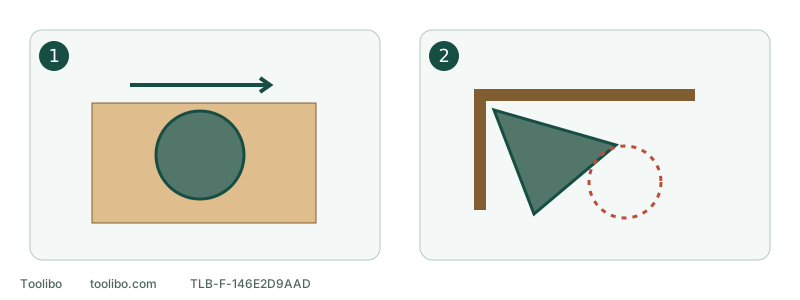
1. Broad flat
Start with random orbit for the main accessible solid-wood surface.
2. Internal corner
Consider detail or hand work rather than tipping the round pad.
A round pad covers open flats; a pointed shape reaches farther into an internal corner.
Models referenced