
A continuing fan, returning heat and an excluded damaged condition
A continuing fan, returning heat and an excluded damaged condition.
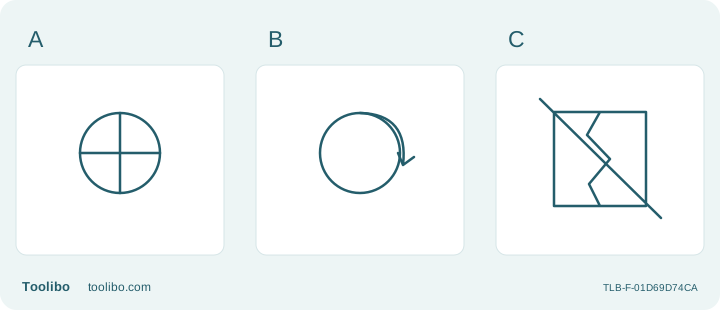
A
The motor may continue while protection interrupts heat.
B
The return arrow warns that heating can restart automatically.
C
Damage or an unexplained repeated event prevents normal use.
A D26950 protection event can leave airflow running and restore heat automatically; external checks start only after shutdown, disconnection and cooling.
Recognize the interrupted-heating pattern
The Canadian DeWalt D26950 instructions describe overload protection that can stop the heating element while the motor continues to run. Heat can return automatically after cooling. This is different from the operator intentionally selecting an unheated fan mode, and it must not be treated as a reliable pause in the heating process.
A running motor with reduced useful heat is therefore an observation to place in context, not an invitation to bring the outlet closer to the work. If heat returns while the nozzle is closer, the object may suddenly receive a different exposure. Stop the material process and follow the applicable shutdown and cooling instructions before investigating what happened.
Preserve the sequence without testing with skin
Record what preceded the event: the airflow switch position, temperature knob position, attachment, elapsed use and the tool’s position relative to the work. Note whether the motor continued and whether heating appeared to resume. Do not deliberately reproduce the cycle, hold a hand in the air stream or touch the nozzle to confirm that it is temporarily cooler.
Describe the observation honestly. “The fan continued and the approved sample stopped responding as before” is more precise than “the element failed.” The sample’s response is not a calibrated heat measurement, and external observation cannot identify a failed internal part. The purpose of the record is to guide safe decisions and give service a clear history.
Stop before the automatic return becomes a surprise
Move the outlet away from the material into the clear safe direction and end use according to N888399. Keep the tool in its permitted cooling arrangement, disconnected after shutdown, and protect the area from accidental contact. The checked manual requires at least thirty minutes before moving or storage, with actual cooling of the nozzle and attachment still necessary.
Do not use the apparent interruption to swap nozzles or put the gun in its case. The metal can remain hot even while the element is not heating, and the powered tool may restore heat automatically. Do not leave the device running while going elsewhere to search for a manual or replacement sample.
Check the external air path while cold
Once disconnected and fully cool, look for an observable obstruction at the inlet, around the outlet or in the surrounding setup. A supporting hand, nearby object or crowded work position can interfere with intended airflow. Check that the accessory is the correct approved part and visibly intact. Do not assume an attachment is suitable simply because it can be pushed onto the nozzle.
Correct only an obvious external arrangement problem within the instructions. Do not poke through the openings, dismantle the casing, modify an attachment or bypass protection. A suspected internal blockage is a service matter. Likewise, visible damage to the cable, plug or housing is a reason to stop rather than to continue testing the airflow hypothesis.
Review recent use before considering another session
N888399 limits on-time to sixty minutes within two hours. Short tasks can accumulate toward that total, especially when several people share the tool. An overload event is not the intended timer for that limit. Record recent use even if the fan never stopped, and do not interpret a lack of warnings as permission to exceed the documented duty restriction.
If the use history is uncertain, say so. Do not invent a precise reset time from the moment the heater appeared to return. The protection behavior and the manual’s operating limit answer different questions. One describes a protective response; the other constrains planned use. Neither guarantees that an unresolved abnormal symptom has disappeared permanently.
Set the service boundary before restarting work
An obvious corrected obstruction may explain the setup, but it does not prove that no damage occurred. Resume only when the applicable instructions permit it and no unresolved damage or abnormal condition remains. If the interruption repeats, has no clear external explanation or is accompanied by another concerning symptom, stop use and contact DeWalt or an appropriate service provider.
Send the model, applicable manual, control positions, attachment and event sequence rather than a guessed component diagnosis. Keep any previously heated sample separate from fresh work until its condition has been assessed. The intended outcome is not to make the protection cycle disappear through experimentation. It is to distinguish an external setup error from a condition that needs professional attention, while remembering that continued airflow never proves safe isolation.
Models referenced