
FURNO 500 controls
Mode and temperature display, crossed timer and upright cooling.
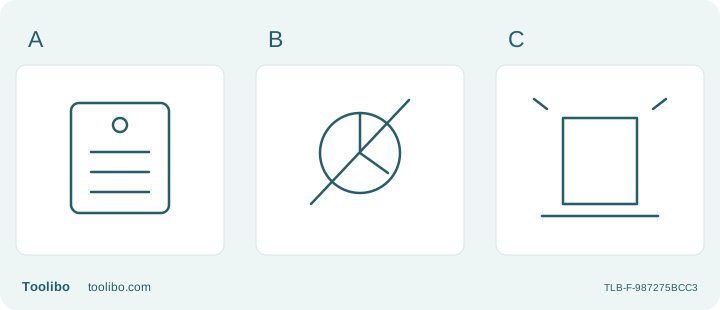
A
Read airflow mode together with the discrete temperature indication.
B
The crossed clock rejects a universal cooling countdown.
C
Keep the nozzle protected until shutdown and actual cooling are complete.
0503749G contains conflicting three-minute and thirty-second cooling wording. Neither duration proves that the metal is safe to touch.
Read mode and temperature together
The US FURNO 500 listing identifies SKU 503063, button controls, two fan settings and a cooling mode. Its manual distinguishes the temperature ranges for low and high airflow. The indicated temperature must be read with the mode, and a selected setting does not measure the material beneath the outlet.
Before another project, check mode and intended heat while pointing into a clear safe area. An earlier trial applies only to its material, attachment and arrangement. An indicator does not make an unknown adhesive, painted item or thin plastic safe to heat.
A running fan may be cooling deliberately
The manual describes entering cooling through the power button, with a blue indication and the heating element deactivated. This explains why the fan may continue after heating has ended. Observe the indication and sequence before reporting that the switch has failed.
The checked manual contains conflicting times: the cooling section describes three minutes, while a later startup step mentions thirty seconds. This guide therefore does not use a timer as proof that the barrel can be touched. Follow the instructions supplied with your unit, supervise completion of the cycle and ask Wagner if behavior or documentation does not agree. Metal may remain hot after the fan stops.
Included nozzles have specific applications
The checked listing includes flare and glass-protection nozzles. Their presence does not authorize heating glass or removing paint in this guide. Choose only the attachment appropriate to a material-permitted application, fitting it when cold and disconnected. A protective nozzle does not eliminate risks to adjacent surfaces or hidden layers.
For a detached heat-tolerant household sample with an approved process, use noncombustible support and let air escape. Do not direct heat into a closed box or around an object whose underside cannot be inspected. Stop if the material changes color, blisters, moves or releases unexpected fumes. Let it cool before reassessment.
Separate normal cooling from dangerous symptoms
If the fan does not start, stop immediately rather than waiting for the element to heat. Damaged insulation, persistent smoke from the tool, sparks or abnormal noise require ending use and obtaining service. They are not equivalent to the documented cooling indication.
After normal shutdown, protect the upright tool and cable until fully cooled, then disconnect and store indoors. Owner tasks are external inspection and approved cleaning. Do not use repeated power cycling, internal probes or an imagined reset to conceal an unexplained fault.
Make a useful inquiry when timing differs
If the supplied document does not match the observed sequence, give Wagner the model, SKU, document identifier and indicator behavior. Explain whether the fan continued and heat appeared to stop, without testing the stream with a hand. Do not decide which printed duration is correct by repeatedly cycling a hot gun.
Until clarified, do not base storage or handling solely on elapsed seconds. Maintain supervision and the prescribed resting position, permit complete cooling and avoid prematurely touching metal. The visible cycle and the physical temperature of an attachment answer different questions; the end of one does not establish the condition of the other.
The same principle applies when changing nozzles. A larger metal attachment can retain heat with the indicator off. Reserve room to leave it fitted until cold instead of removing it just to close the case. This guide invents neither a timer nor a reset sequence: neither would resolve the contradiction or demonstrate that your particular unit is operating normally.
Read the verified operating values
The US FURNO 500’s low-airflow mode covers discrete settings from 150–1050°F; high-airflow mode covers 200–1200°F. The LED pattern identifies a selected step, not an arbitrary continuously variable temperature. Startup selects low airflow at 150°F. Changing mode changes the available temperature choices as well as airflow. These are tool output settings, not measured material temperatures; the lower limit does not grant permission to heat an otherwise unsuitable object.
Models referenced